
Tent Rentals / Wedding Tent Rentals
Wedding tent rentals that make your property the venue
Wedding tent rentals let you hold the whole day on ground you already love, with the floor, the lighting, the heat and the layout built around it. We own the tents, we own the trucks, and our crew puts them up.
What you are actually renting
A venue you build on a property you already love
A wedding tent is a building that stands for a few days. It covers the dinner, the dancing, the bar and often the ceremony, and then it comes down and the lawn goes back to being a lawn. Couples choose one for a plain reason: the place they want to be married is not a catering hall. It is a family backyard, a rented estate, a waterfront lot, a field behind a farmhouse.
What a tent gives you is control. A venue hands you a room, a closing time and a list of vendors you are allowed to use. A tent hands you an empty footprint and lets you decide where the dance floor sits, how long the night runs and who cooks. What you take on in exchange is everything a building already has: a level floor, light, power, somewhere for the caterer to work, heat if the night turns cold, and a plan for weather. That is the work, and that is the part we do.
It also has to look right. Your tent is in every photograph taken after four o'clock, so the roof, the poles and the way the light sits under them matter as much as the span. A sailcloth top glowing over a lawn reads very differently from a white frame tent, and both are correct answers depending on the property and the look you are after.
Real installs
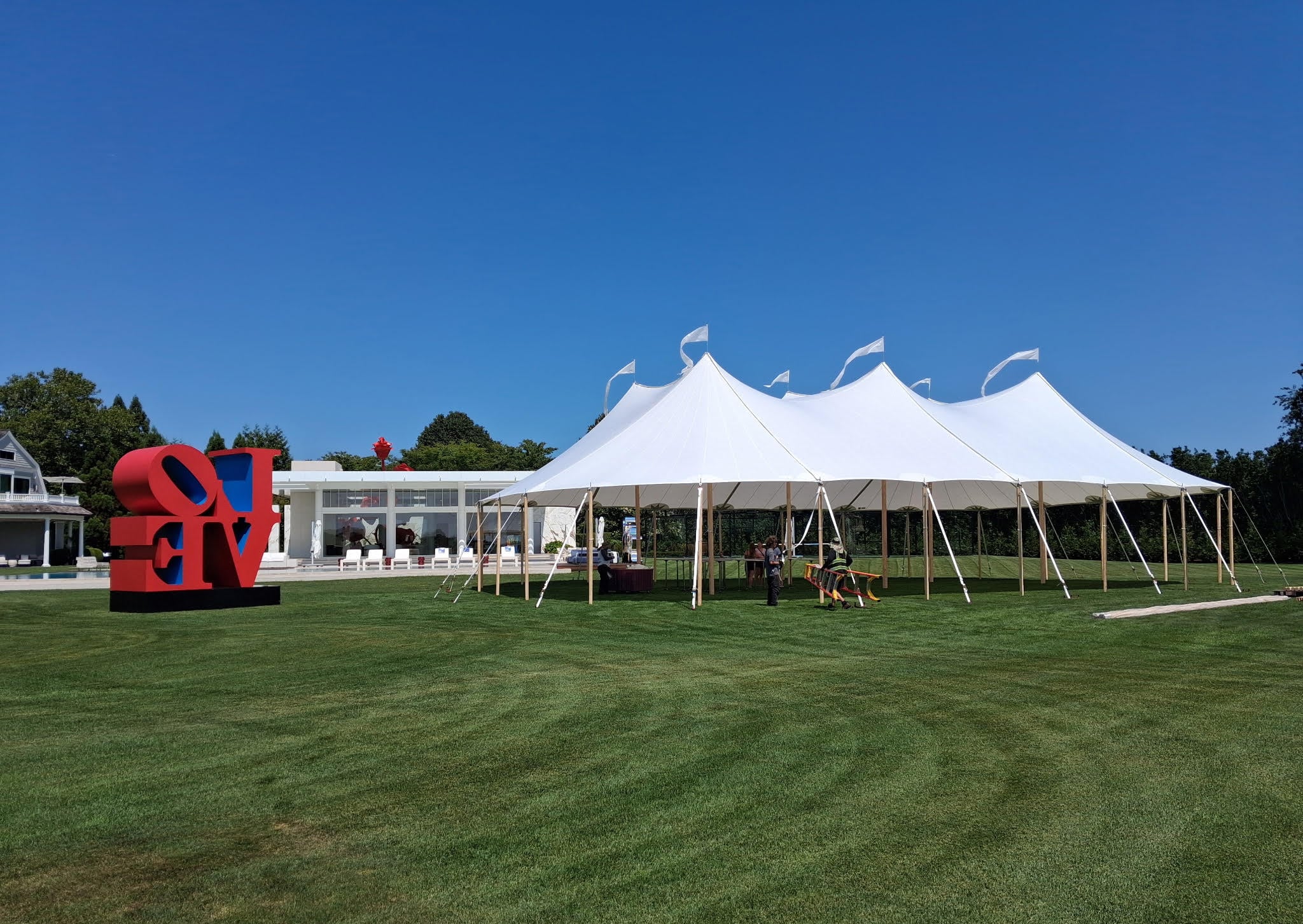
Sailcloth and pole tents we have built for weddings
Photographs from our own jobs. Open any one of them for the full set.
Browse and build your list
See the wedding inventory and start a list
Tents, flooring, lighting, heat, tables and linens sit in one catalog. Build the list you think you need and we will tell you what it actually takes.
Wedding rentals
A wedding install, start to finish
What a wedding tent looks like going up
A lawn becomes a room in a few hours, and most of that work happens long before the first guest sees it. This is the part couples never watch, because it happens on a weekday while they are somewhere else.
The crew in this video is our crew. They are the same people who come back after the wedding to take it all down, and the same people who walked the lawn with you months earlier.
Is this your wedding
Four ways hosts end up calling us
Most couples arrive at a tent from one of these four places. If more than one sounds like your day, the answer is usually yes.
The guest list outgrew the house
Forty people fit on a patio. A hundred and forty do not, and once you add a bar, a band and a place to eat, the yard stops being big enough on its own.
You already have the place
A family property, a house you rented for the week, a farm or a waterfront lawn. The setting is the reason for the wedding, so the venue has to come to it.
The ceremony is outdoors
An open-air ceremony needs a real answer for rain, not a group text at noon. A tent that is already standing turns the forecast into a detail instead of a decision.
You want the day on your clock
No four-hour block, no second seating waiting on the room, no caterer you did not pick. You set the timing and the vendors, and the tent holds whatever you decide.
Plan the footprint
Reception footprint planner
Tell it how your guests sit for dinner, where the music lives and how your caterer works. It draws the reception back as a footprint with the dance floor, the band and the service area broken out, so you can see what the night actually occupies before anyone measures the lawn.
The blocks are drawn in proportion to floor area. The frame around them is the aisle and entry space a room this size needs.
Tents come in set sizes, so the floor area is the nearest one that holds the reception with room to move. A planning number, not a quote: slope, tree cover, driveway access and where your caterer needs to work all move it. We confirm the real footprint once we walk the property.
How the job runs
From the first walk of the lawn to the empty grass
Six stages, in the order our crew does them. Most of the decisions that matter are made in the first two.
Site survey
We measure the usable area, which is almost never the total area. Where the ground falls away, how low the branches hang, what is buried under the lawn, what crosses it overhead and how a box truck gets to the spot and back out again all narrow the choices before a single size is discussed.
Layout and quote
We draw the footprint with the dance floor, the bar, the buffet and the seating where they belong, then price the tent and everything under it in one document. This is where a size on paper becomes a shape that fits your lawn.
Delivery
Everything for your wedding loads onto our own trucks in Holtsville and arrives together, usually a day or more ahead. We stage the drop so the frame goes down where it gets built and nothing heavy is dragged across a lawn you want photographed on Saturday.
Install
Anchoring comes first and it follows the surface: stakes into turf, ballast onto pavers and decking. Then the top goes up, the poles and sidewalls go in, and the floor and lighting are built out to match the layout you approved. We finish before your caterer, florist and band arrive.
Wedding day
The tent is standing and walked through before the first guest turns into the driveway. Somebody who knows your install stays reachable all night, so a sidewall that has to come down at nine, or a heater that needs turning up, is a two-minute phone call and not a problem you have to solve in the middle of your own wedding.
Breakdown
We come back on the agreed day, strike the tent, load out and leave the ground the way we found it. Stakes come out, ballast goes back on the truck, and the property is yours again.
Choosing the tent
Four families that suit a wedding, and when each one wins
Span is only half the decision. The frame type changes the ceiling, the poles inside the room, the ground you can build on and the way the tent photographs after dark.
Sailcloth
Translucent top on wooden poles. It glows at dusk and reads warm rather than white, which is why it is the default request for a lawn wedding. Center poles sit inside the room, so the layout has to be drawn around them.
Sailcloth tent rentals
Clear top
A transparent roof that keeps the sky and the tree line in the room. Best for evening receptions and for properties where the view above you is the point. Daytime sun needs a plan, so we talk about shade and cooling early.
Clear top tent rentals
High peak frame
Pointed peaks with no interior poles, so the floor plan is yours. A frame tent can sit close to a house or over a patio where a pole tent cannot, which makes it the practical choice on tighter properties.
High peak tent rentals
Clearspan structure
Engineered aluminum spans with a clear interior and straight walls. This is what you use for a large guest count, a long dinner plus dancing under one roof, or a site where the tent has to stand for a week.
Structure tent rentals
What moves the number
The eight things that decide what a wedding tent costs
We do not quote a tent by guest count alone, because two weddings with the same guest list can be very different jobs. These are the factors we work through on the first call.
| Factor | Why it moves the number | What we ask you |
|---|---|---|
| Span and size | A wider clear span needs heavier frame components and more crew hours than the same square footage in a narrower tent. | Guest count, seating style and whether dinner and dancing share one roof. |
| Duration on site | A tent up for one night and a tent up for a week are different jobs. Longer stands need more weather checking and hold the equipment out of the fleet. | Your install day, your wedding day and the earliest we can strike. |
| Surface and ground | Turf takes stakes. Asphalt, gravel, decking and patios take ballast, which means weight on trucks and time on site. Sloped ground needs leveling before anything else happens. | What the tent is landing on, and how flat it really is. |
| Sidewalls | Solid walls, window walls and a fully open tent are three different builds. Walls also change how heat behaves inside the room. | Whether you want the sides open, and what your rain plan is. Our tent accessories page covers the options. |
| Flooring | A tent on grass is the cheapest floor. Subfloor, carpet or a raised deck costs more and is sometimes the only way to make sloped or wet ground usable. | Whether you want a full floor, and where the dance floor or event flooring goes. |
| Lighting | String lights, chandeliers, pole drapes and uplighting are separate installs with separate power needs. Lighting is usually the difference between a tent and a room. | The look you are after, and whether your band or DJ is bringing their own rig. |
| Heat and climate | Spring and fall nights on Long Island drop fast. Heaters, fuel and the sidewalls that hold the warmth in are all part of the same decision. | Your date, and how late the reception runs. |
| Access and distance | A crew that can back a truck to the tent site works faster than one carrying frame sections two hundred feet across a lawn. Gates, soft ground and narrow drives all add hours. | How a box truck reaches the spot, and what it has to pass through to get there. |
Local conditions
What Long Island does to a tent install
The same tent behaves differently a mile from open water than it does behind a tree line. These are the conditions that change our spec most often.
Wind off open water
A South Fork lawn or a bayfront yard takes wind that an inland property never sees, and it arrives with nothing to break it. Those sites get heavier anchoring, more of it, and a sidewall plan that can change during the night.
Soft spring ground
Ground that thawed in March holds a stake differently than the same lawn in August, and a loaded truck sinks into it. May weddings often need matting under the wheels and a different anchoring approach than the identical tent in July.
Sand and loose soil
Near the beach the soil does not grip. Sandy ground calls for longer anchors or ballast instead of stakes, and we would rather work that out at the survey than discover it with a mallet the morning of.
Mature tree cover
Old oaks are why people fall in love with these properties, and they are also why a tent sometimes cannot go where you pictured it. Limb height and root systems decide whether a peaked top clears and where the anchors can bite.
Pools, patios and hardscape
Plenty of backyard weddings here are built around a pool. A tent can be laid out to work with it, but it means ballast on the pavers, a frame that does not need center poles in the wrong spot, and a walkway plan people can follow after dark.
Town paperwork
Tents over a certain size generally need approval before they go up, and the standard changes from one town hall to the next. Some want drawings of where the structure sits. Give us the address early and the paperwork becomes a scheduling item rather than a scramble in the last two weeks.
Who is putting it up
Our tents, our trucks, our crew
Plenty of companies will sell you a wedding tent they do not own and hire somebody else to build it. We do not work that way. The tents live on our racks in Holtsville, the flooring and lighting and heaters sit in the same building, and the people who load the truck are the people who stake the first corner into your lawn.
For a wedding that matters more than it sounds. One delivery instead of four. One crew moving around your property instead of three companies working over each other in a driveway. One number when the forecast turns on Thursday night. And because the equipment is ours, a change to the layout on Wednesday is a decision we make, not a request we forward to somebody else and wait on.
In our customers' words
Couples who held the wedding at home
We sit at 4.9 stars across 138 Google reviews. Three of them, word for word.
"We rented our tent from TGIF for our backyard wedding, and it was one of the best decisions we made. We weren't sure a tent would work around our pool, but Mike reassured us that his team could make it happen. He was quick to answer every question, and the setup team was prompt and professional. Highly recommend!"
"I was looking for an elegant setup for my event, and TGIF knocked it out of the park. Their sailcloth tent looked incredible, and the final result exceeded my expectations."
"TGIF handled my event in the Hamptons, and I needed everything to look elegant without becoming too expensive. They delivered exactly what I was looking for."
Straight answers
What couples ask us before they book
Talk to us
Tell us about the property
Bring the date, the address and a rough guest count. We will tell you what fits on that ground, what the install takes and what we would do differently if it were our lawn.