
Tent Rentals / Disaster Relief Tent Rentals
Disaster relief tent rentals for agencies working on somebody else's clock
Disaster relief tent rentals put covered, lit, powered floor space on a site that has none, at short notice, for a length of time nobody can name yet. That last part is what separates this work from an event.
What this work is
A structure is the fastest square footage anyone can hand you
After a storm the shortage is rarely people. It is usable indoor space. Buildings are wet, dark, condemned or already full, and every function that happens next needs a roof, a floor and somewhere to plug something in.
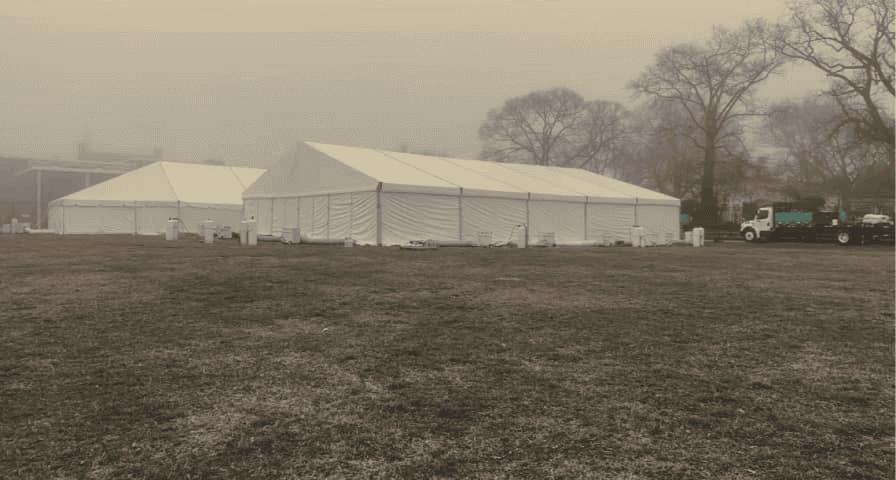
The structures that do this are the same engineered clearspan frames we set for festivals and corporate installs. Nothing is improvised. They truck in sections, anchor to grass or asphalt, and go back up elsewhere when the first site is done with them.
Our event business covers Nassau, Suffolk and New York City. Relief work is the one exception on this site: we have sent equipment and crews outside the Tri-State area when a response needed them.
What ends up under the roof
From our own jobs
Structures on relief and response sites
Browse and build your list
See the structures and the systems
Disaster relief equipment
Why the same equipment works
Every feature that sells a tent to a wedding earns its keep here
The engineering behind a five hundred person dinner is the engineering behind a shelter floor. Only the reasons change.
| Feature | At an event | On a deployment |
|---|---|---|
| Clear span, no interior poles | An unbroken room for tables and sightlines. | A floor you can re-plan on day four. Cot rows, a triage lane and a sorting line all fit the same empty box. |
| Length built in bays | The tent grows to the guest list. | The structure grows to the caseload. Add bays instead of striking and starting again. |
| Engineered anchoring | Stakes on a lawn, ballast on hardscape. | The lot you were given is usually asphalt. Ballast means the surface you got does not have to be the one you wanted. |
| Solid walls and hard doors | Weather protection and a defined entrance. | A closed envelope you can heat, cool, light and control access to, with separate ways in and out. |
| Designed to come apart | Out the morning after, lawn back to normal. | The stand can extend, shrink, or reopen on a second site without buying anything. |
The real difference
Four ways a deployment is not an event
An event has a date, an address, a headcount and a strike time, all known months out. A deployment has none of those.
The site is unknown
No walkthrough happened in March. The lot may be asphalt, ballfield, mud or a school lot with light poles through the middle of it, so we load anchoring for more than one surface.
The end date moves
Almost every relief stand runs longer than the first estimate. Write it so extending is a phone call. Equipment promised to a wedding on Saturday is the wrong equipment for this.
Power starts at zero
At a venue there is a panel on the wall. Here there may be no grid at all, so heat, light and outlets arrive on a truck and get sized before anyone works inside.
Nobody plans the strike
Operations wind down in stages, hand off or move. The useful question is what happens when half of it is no longer needed and the other half keeps running.
The rest of the building
A tent is a roof. Everything that makes it usable arrives with it
None of this is already on a relief site. Each system gets sized against the function, not the square footage, and each rides the same manifest as the frame.
Power
Everything else runs off it. Generators and distribution get sized to the real load: heat, refrigeration and a great deal of charging.
Climate
A sealed structure holds conditioned air, which is the whole point of a warming or cooling center. Heating and climate control is sized to the envelope and how often the doors open.
Flooring
Ground that was fine on day one is not fine after a week of traffic. Event flooring keeps cots level and gives cable somewhere to run.
Light
Operations run past dark from the first night. Lighting covers the floor, the entrances and the walk out to parking, which is where people get hurt.
Restrooms and washing
Count follows headcount and duration, and this is the item most often underordered. Portable restrooms and wash stations need a servicing schedule, not just a delivery.
The envelope itself
Solid walls, clear panels where daylight helps, hard doors that latch, one controlled way in. A structure you can close is one you can staff overnight with two people instead of six.
Pick the function, see what it takes
Deployment scale guide
Choose what the covered space has to do. Each one shows the structure that suits it, the systems that must come with it, and what actually decides how fast it stands up.
The structure
A wide clear span, solid walls, hard doors. No interior poles, because cot rows and a family area get re-laid as the count changes. Bays added as the population grows.
What comes with it
Flooring across the full footprint. Climate sized to hold overnight. Low light that can stay on. Restrooms to headcount. Power for climate plus charging, which is heavier than most first estimates.
What sets the speed
Flooring, not the tent. Laying floor across a large footprint takes longer than raising the frame over it, so a floored shelter is a different day than an open structure.
The structure
Two structures pretending to be one: a dining space and a separate covered kitchen. Cooking heat, grease and ventilation want their own envelope, joined but zoned away from the tables.
What comes with it
The heaviest power draw on this page once refrigeration and hot holding run. Hard flooring on the production side, light over the line, hand washing at the entry, a queue kept clear of the cooking zone.
What sets the speed
The kitchen side, every time. The dining structure is a normal install. Production waits on power, ventilation clearances and whoever brings the cooking equipment.
The structure
Long and narrow beats wide and square, because this is a flow problem. Separate entrance and exit, hard doors at both ends, solid walls for privacy, partitioning for bays.
What comes with it
Clean level flooring. Climate held at a stable working temperature, not just taking the edge off. Bright even light, no dark corners. Power that does not dip, because clinical equipment will not tolerate it.
What sets the speed
Siting, then partitioning. Finding a spot that is close, level and clear of ambulance routes usually takes longer than the install itself.
The structure
The smallest thing on the list and usually the first one asked for. A compact enclosed span you can hear yourself think in, often paired with open-sided cover for staging.
What comes with it
Steady power with more outlets than seems reasonable. Task light over tables. Climate, since this one is occupied around the clock. Flooring for cable under a lot of laptops and radios.
What sets the speed
Little. A small enclosed structure with power and light can be working within hours of the trucks reaching usable ground, which is why it goes up first.
The structure
Several, not one: a dining and break space, a briefing space, covered gear storage, and open cover over the yard where trucks stage. Usually asphalt or a ballfield.
What comes with it
Everything, and for weeks. Power, heat, light, hard flooring, restrooms and washing on a real servicing schedule, plus light across the yard and the routes between structures.
What sets the speed
Truck turnarounds. A basecamp is four or five installs in sequence, built in priority order: dining and restrooms first, storage and yard cover after.
The structure
Open-sided and wide, with clearance under the eave for a pallet jack. Sidewalls on the weather side only. Covered storage behind the line, so stock is not in the rain.
What comes with it
Light for early and late hours. Modest power. Ground protection where wheels run, which matters more here than finished flooring. Anchoring for an open structure, which takes more wind load.
What sets the speed
Quickest of the large structures: no floor to lay, no envelope to seal. Setting it so traffic flows one way without backing onto a public road takes the thought.
How a mobilization runs
From the first call to a structure that is working
The first two stages happen on the phone and by photograph, because on this kind of job a site visit is often a luxury nobody has.
Scope the function
What the space has to do, for how many, and whether it is one structure or four. Short conversation, and it sets everything downstream.
Read the site remotely
Photographs, a map pin, and answers on surface, slope, overhead wires, gate widths and truck turning. Imperfect, and far better than arriving blind.
Load to the plan
Frame, walls, flooring, anchoring for more than one surface, and the power, climate and light package. Loading for two surfaces saves a return trip.
Set and commission
Frame, cover, anchoring, walls, floor, then power and climate brought up and checked before handover. It is finished when it works, not when it is standing.
Hold the stand
Scheduled checks on anchoring and fabric, fuel and servicing on whatever runs, and someone here who knows your site by name rather than by ticket number.
Extend, shrink or move
Add bays, pull a structure while the rest keeps running, or strike and reopen elsewhere. All three are normal and none needs a new negotiation.
Why the fleet matters here
When everyone needs the same gear in the same week
Regional weather does not create one customer, it creates forty at once. A broker who subrents from three suppliers is bidding against you for the same inventory.
Tents owned outright, grown from the two the family started with. Nothing here is subrented from another yard.
The family business began. Michael Biondi has run it since 2007 and is who you get on the phone.
Warehouse, in Holtsville off the Long Island Expressway. One building to load from, not a network of yards.
Stars across 138 Google reviews, from the same crews and equipment that go out on a deployment.
Owning the equipment decides two things on a relief job. Whether a stand can extend in week three, because the structure over your head is not promised to a wedding on the fifteenth. And how fast a second structure follows the first, because adding one is a load-out from our own rack. Running our own crews does the same for the schedule: the people who set the frame come back to check it. At the largest footprints this is the capability behind our large tent rentals.
Before you call
What to have in front of you
You do not need all of this, and nobody should sit on a request until they have it. Start with the function and the site. The rest can be filled in while equipment is pulled.
If an answer is genuinely unknown, say so rather than guessing. An unknown we are told about gets planned around. A wrong guess gets discovered on the lot with the truck unloaded.
The list
The function or functions, and roughly how many people at once.
Address or map pin, plus photographs of the actual ground in both directions.
Surface: grass, asphalt, gravel, ballfield or mixed, and any slope you can see.
Overhead wires, light poles, irrigation, tree lines, anything buried you know about.
Gate width, truck access, and somewhere a tractor trailer can turn.
Whether any power exists on site, or none at all.
Your best guess at duration, plus what happens if it doubles.
Who approves the layout, who signs, and who we call at two in the morning.
The same crew, the same warehouse
What our customers say
Our public reviews come from event clients, because that is most of what we do. The trucks, the racks and the people are the same ones that go out on a deployment.
"TGIF handled my event in Suffolk County, and they absolutely exceeded my expectations. The setup was perfect, the event went beautifully, and the team did an excellent job."
"I had a corporate event with TGIF, and I still can't get over how easy they made everything. Every detail needed to be perfect, and somehow the result was even better than perfect."
Straight answers
What emergency managers ask us first
Talk to us
Tell us the function and the site
Two things get a useful answer out of the first call: what the covered space has to do, and where it is going. Photographs help more than descriptions.