
Tent Rentals / Festival Tent Rentals
Festival tent rentals built for a public event that runs for days
Festival tent rentals have to do a different job than a backyard party tent. The structures go up before the public arrives, hold vendors, food service and a stage, and then stand through whatever the forecast does for the length of the run.
The job a festival tent does
Scale, weather, and a schedule that runs all week
A festival tent is closer to a temporary building than to a party canopy. It covers vendors, food service, a beer garden or a stage, it has to be safe with a crowd moving underneath it, and it has to keep doing that on Friday night and again on Sunday afternoon. Nothing about that is a one afternoon job.
Most of the pressure on a festival build comes from the calendar rather than the tent. A town fair that opens Saturday morning wants its structures standing by Thursday so vendors can load in on Friday. A three day food and wine event needs that same footprint held for four nights. Races, fundraisers, concerts and vendor markets all run on the same shape: install early, hold it, strike fast once the field empties.
The other pressure is the public. A private party has forty guests who all know the host. A festival has a crowd that arrives in waves, moves between rows, and does not look at where the anchor lines are. That changes where structures land, how wide the aisles run, where anchoring can sit, and how power gets routed so nobody walks across a cable.
Real installs
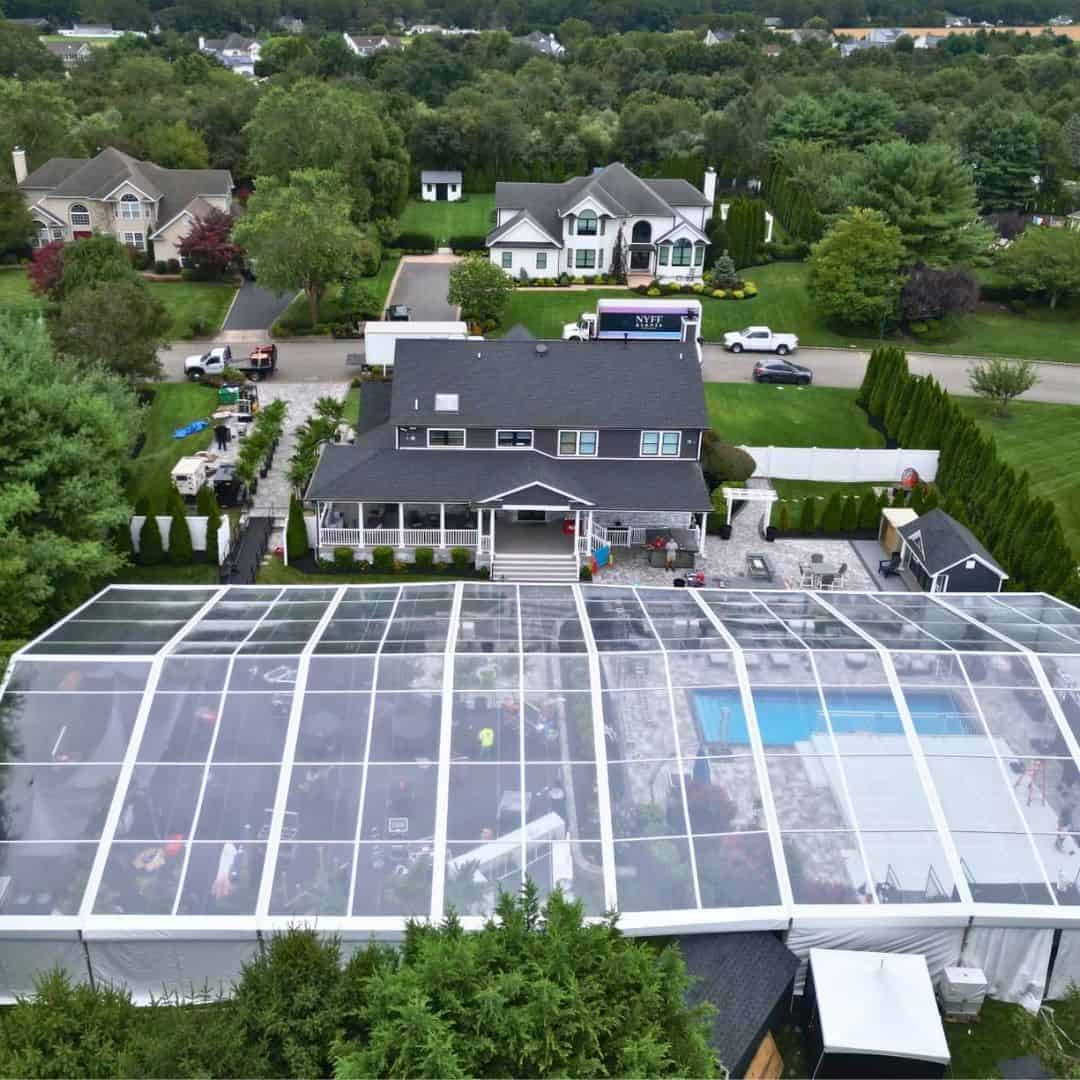
Clearspan structures from our own fleet
Structure tents on Long Island sites. Open any photo for the full set.
Browse and build your list
See the festival inventory
Spans, systems and the site gear that goes with them, with what is actually free on your dates.
Festival rentals
The structures that carry scale
Four systems that hold a festival footprint
Span gets chosen by what has to happen underneath it: clear floor for vendor rows, headroom for a stage, or a width the crowd never has to walk around.
Clearspan structure tents
No interior poles at all, so the whole floor is usable. That is what a vendor market, a beer garden or a seated dinner under one roof actually needs. Structure tents also take sidewalls, doors and flooring cleanly, so you can close one side against wind and leave the rest open.
Structure tent rentals
Navi-Trac clearspan
An engineered clearspan system that builds in sections, so a run can be extended to the length the site wants rather than the length the tent arrived in. Useful where a footprint is long and narrow, like a vendor row down one side of a field.
Navi-Trac tent rentals
Jumbo-Trac clearspan
The heavier clearspan system, for the widest span on the site. When the main tent has to hold a stage, a crowd and a bar without a single leg in the middle of the floor, this is usually the one that lands at the center of the plan.
Jumbo-Trac tent rentals
High peak frame tents
Pointed center peaks, frame built, and quick to repeat across a site. Festivals use these in rows: one per vendor, one over registration, one over the first aid point. They read from across a field and they go up and come down fast.
High peak tent rentals
Plan the week, not the day
Step through a multi-day load-in
A festival does not have a setup day, it has a setup week. Walk the six stages below to see what happens when, what our crew owns, and what stays with you.
Site walk
We come out to the field, the lot or the green and measure what is usable, not what is on the map. Slope, tree cover, overhead wires, irrigation heads, gate widths and where a loaded truck can turn around all get noted, because every one of them moves the footprint.
This is also where the layout conversation happens. How many vendors, which way the stage faces, where the crowd comes in, how far power has to reach. The plan that comes out of this walk is the one the crew builds from.
Mark out and paperwork
The agreed footprint gets marked on the ground so everybody is looking at the same thing: tent corners, leg positions, aisles, and the service lanes that stay clear. Utility locates get done before a stake goes anywhere near the dirt.
Most towns, parks and venues on Long Island want paperwork on a tent before it goes up, and the requirement is not the same from one town to the next. Tell us what your office is asking for and we work to it.
Install days
Trucks arrive and the structures go up in the order the site needs them: the main span first, vendor rows after, then sidewalls, flooring and anything hanging inside. Anchoring is set to the surface, stakes where the ground takes them and ballast where it does not.
The site is a work area while this runs. Vehicles, the public and early vendor deliveries all stay out of it until the crew hands it over, and that one rule is what keeps an install on schedule.
Vendor load-in
The tents are standing, the floor is down and power is distributed, so vendors can pull in, find their marked spot and set up. Tables, chairs and the rest of the rental list are staged where the layout put them.
This day runs on your schedule rather than ours. Staggering arrival times by row keeps the service lanes open and stops the whole field queueing at one gate.
The event days
The structures stand and we stay reachable. Anchoring gets checked between days, sidewalls go on or come off as the forecast moves, and if something has to change you are calling the company that owns the tent instead of a dispatcher at a firm somebody hired.
Decisions about the crowd stay with you and the venue. We tell you what the structure needs and what we can do about it. Whether the gates stay open is your call to make with the town.
Strike and load-out
We come back on the agreed day, take the structures down in reverse order and load out. Flooring, sidewalls, lighting and site gear go back on the same trucks as the tents.
The ground gets left the way we found it. What we need from you is the tents emptied first: vendor gear, rubbish and anything stored under a top has to be clear before a crew can start dropping a span.
Book the walk before you promise vendors their spots. Moving a booth row on paper costs nothing. Moving it after the tents are up costs a day.
This is the stage that slips most often. Start the permit conversation the week you book, not the week you load in.
Give the install its own days on your schedule. Vendors arriving into a live build is how load-in mornings go wrong.
Booth positions painted on the ground the night before save an hour of pointing on load-in morning.
Name one person who can make a call without ringing three others. On a multi-day event that role matters more than any single piece of equipment.
Strike day is usually the day the field goes back to the town or the school. Put it on the permit and the schedule from the start.
Where festivals actually happen
The ground decides how the tent is held down
Almost no festival happens on a manicured lawn. Here is what the surfaces you are likely to be standing on change about the install.
| Surface | How the tent is held | What to settle first |
|---|---|---|
| Turf or athletic field | Stakes drive well and anchoring is usually straightforward. | The field owner's rules. Plenty of school and park fields limit stake depth or bar staking near irrigation and drainage runs, and you want that answer before the layout is drawn. |
| Asphalt or concrete lot | No staking at all, so every leg is ballasted with weight. | Truck access to each leg. Ballast is heavy, it has to be placed and taken back out, and it sits in the floor area around the perimeter. |
| Packed dirt and gravel | Holds a stake, but not evenly across a site. | Leg by leg checks. Compacted fill can be soft a foot down, and a stake that pulls on day one is worse than one that never went in. |
| Waterfront and sand | Loose ground with open wind coming off the water. | The anchoring plan. This is the combination that needs the most hardware and the most attention across a run of several days. |
| Village green or park lawn | Stakes are fine. The surface afterward is the issue. | Ground protection under vehicle paths and the busiest aisles. It keeps the turf usable and keeps you on good terms with the parks department. |
Four days of weather is not one day of weather
A tent up for six hours sees one forecast. A tent standing from Wednesday to Monday sees four or five of them, including the overnight ones nobody was watching. That is why the anchoring plan, the sidewall plan and the check schedule on a festival look different from a backyard job, and why our crew comes back between event days rather than waiting for the strike date.
Sidewalls are the usual answer to a bad forecast and they are worth deciding on early. They can hang on one weather side and stay off everywhere else, and clear panel walls keep the sight lines open when you close a side. Rain coming off a big span also has to land somewhere, which is part of why a footprint ends up where it does.
What moves the number
What decides the cost of a festival tent
We quote a festival as a site, not as a line item. These are the things that move the figure, and none of them are a mystery once the site walk is done.
Footprint and span
Square footage is the starting point, but the span matters as much. A clear width costs more to achieve than the same area split across two smaller tents, and sometimes two tents is the better answer for the layout anyway.
How many days it stands
Standing time is priced. A structure held from Wednesday to Monday is off the availability list for the whole week, and it carries more weather the longer it is out there.
Surface and anchoring
Ballast on a parking lot is a different job from stakes in a field. Weight has to be trucked in, placed and taken back out again, and that shows up in both the labor and the equipment.
The load-in window
A site that can be worked in daylight across two days prices differently from one where the lot is cleared, built overnight and handed back before the gates open. The tighter the window, the more crew.
Sidewalls, flooring and light
What goes on and under the tent is the second half of most festival quotes. Sidewalls, ground protection, lighting and the power to run it get decided at layout, not on the day.
Where the date sits
Peak weekends on Long Island go first, and a holiday weekend with three events across two counties draws on the same fleet and the same crew. Booking early is the cheapest thing on this list.
What comes with the tent
The rest of what a festival site runs on
The tents are the first thing on the plan and rarely the last. These four come up on almost every public event we quote.
Generators and distribution
Food vendors, a stage, lighting and card readers all pull from somewhere. Power gets planned alongside the layout so cable runs sit under mats or behind barriers instead of across an aisle.
Generator and power rentals
Portable restrooms
Crowd size and event length decide the count, and placement decides whether the line blocks a vendor row. Restrooms want their own service access for every day the event runs.
Portable restroom rentals
Crowd control and entries
Barricade, stanchion and rope turn an open field into a route: one way in, a queue that does not fold back on itself, and a clear edge around the stage, the bar and the exits.
Crowd control and red carpet
Staging and decks
Music events, award presentations and opening remarks all want a deck and a clear sight line. Stage size and height get set against the tent span so headroom, lighting and the crowd all work under one roof.
Stage rentals
Flooring, lighting, heat, tables and chairs come off the same racks in Holtsville and land on the same quote. One delivery, one crew on your site, and one number to call when the schedule moves.
In our customers' words
What organizers say once the trucks have gone
We sit at 4.9 stars across 138 Google reviews. Three of them, word for word.
"TGIF provided excellent communication and great service. Our party was a huge success, and everything was delivered at a great price. I will definitely use them again and recommend them to anyone planning an event."
"TGIF handled my event in the Hamptons, and I needed everything to look elegant without becoming too expensive. They delivered exactly what I was looking for."
"I was looking for an elegant setup for my event, and TGIF knocked it out of the park. Their sailcloth tent looked incredible, and the final result exceeded my expectations."
Straight answers
Festival tent questions we get asked first
Talk to us
Bring us the date and the site
Tell us where the event is, how many days it runs and roughly how much ground you need covered. We will tell you what the install actually takes and what it costs.