
Tent Rentals / Corporate Tent Rentals
Corporate tent rentals that hold a hard start time
Corporate tent rentals give you a room where there is no room: a campus lawn, a parking lot, a job site, a block in the city. We own the tents, the flooring, the power and the crew that installs all of it, so the load-in window your building gave you is the one we work to.
Built for the person who gets blamed
The tent is the easy part. The schedule is the job.
A corporate event has a start time somebody already published. Guests arrive at eleven, the president speaks at noon, the doors close at four, and the lot has to be clear before the Monday shift. Everything we do on your site is scheduled backward from those numbers.
That is what separates this from a backyard party. A homeowner can push the party an hour. You cannot. So the first questions we ask are not about fabric. They are about the gate, the dock, the surface, the certificate your risk team needs before a truck rolls in, and who on your side can make a decision at seven in the morning.
We can answer those questions ourselves because we own what we are quoting. The tent, the floor, the staging, the generators, the heat, the tables and the linens leave one warehouse in Holtsville on one manifest, and our own crew builds them. There is no second vendor to chase and no install company you have never spoken to sitting at your gate.
Corporate work
Tents we have put up for companies
Photographs from our own installs. Tap any of them to open the full set.
Formats we set up most
Seven corporate formats, seven different builds
The word tent covers a lot of ground. What you are running decides the span, the floor and how long our crew is standing on your property.
Company picnic
Families, food lines, games and a flat field. The tent is shade and rain insurance more than a room, so the span runs wide, the sides stay open and the ground is usually turf. Head count moves late, so we size for the RSVP plus the people who turn up anyway.
Product launch
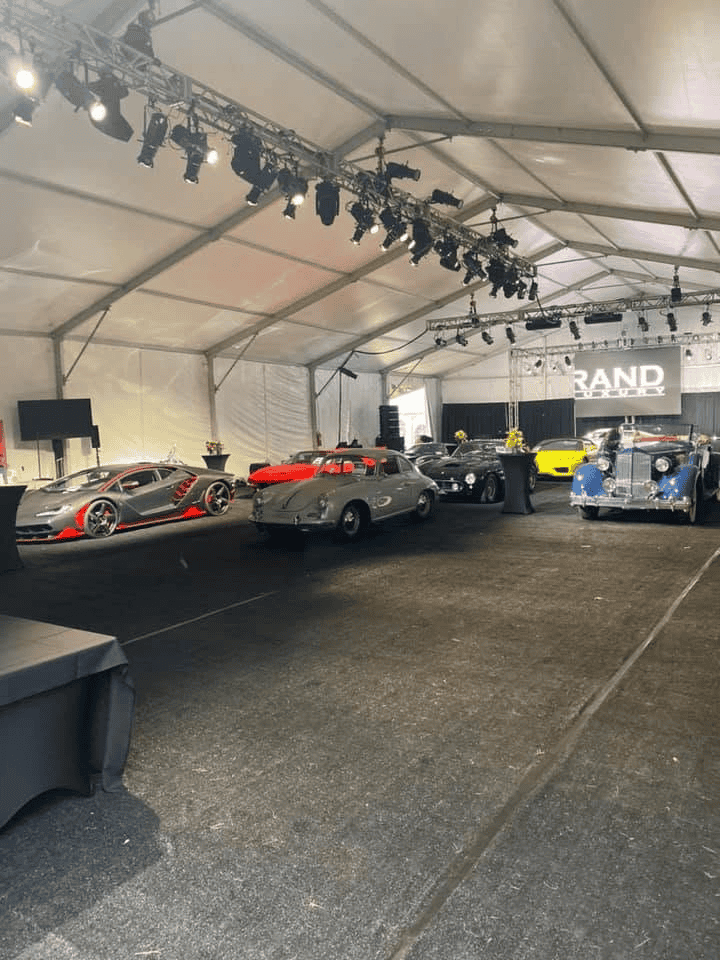
The tent is the set. A clearspan with no interior poles keeps the reveal and the camera clean, and the lighting and power plan gets drawn before the seating chart does. These builds take the longest and they are the least forgiving.
Hospitality tent
A branded room beside something already happening: a tournament, a race, a trade show, a client outing. Access is tight, the neighbors on either side matter, and install often happens overnight or in a window somebody else controls.
Conference overflow
The building filled up. A tent on the lawn or the lot picks up breakout rooms, registration or lunch service, and it has to feel like part of the building. That means a hard floor, walls, climate control and a covered walkway people will actually use.
Grand opening
Short, public and outdoors. A tent over the entrance and the ribbon keeps the morning on schedule whatever the sky is doing, and the line of people waiting needs somewhere to stand that is not the road.
Campus event
Employee appreciation days, town halls, holiday parties and summer series on company property. It is the same ground every year, which means by the second one we already know where the irrigation runs and where a loaded truck can turn around.
Job site and industrial events
Topping out lunches, safety milestones, plant anniversaries and shift meals on active sites. The surface is gravel, dirt or slab, the access route changes week to week, and everything we bring has to work around equipment that is still moving.
Ballast, not stakes
See a corporate install
What it looks like when the trucks pull in
This is the corporate side of our work: tents going up on company property and on hard surfaces, with flooring, lighting and power built into the plan rather than added on the morning of. Watch how much of it is structure and how little of it is improvisation.
Almost all of what you are seeing was decided weeks earlier, on a site walk, with a tape measure and a load-in schedule. The crew in the video is our crew, and they are the same people who come back to take it down.
Plan it by format
A site checklist that changes with the event
Pick what you are running. The list rewrites itself to the seven things that decide whether your day holds, and every line points at the gear that handles it.
A picnic is a shade and weather job on soft ground. Get the span and the restroom count right and most of the rest takes care of itself.
| Site system | What to plan for |
|---|---|
| Span and structure | Wide span, sides open, interior poles acceptable. Size for the RSVP plus the walk-ups. |
| Flooring and subfloor | Usually none on turf. Put matting under the food line and the bar, where the grass takes the beating. |
| Power | Catering and music loads at minimum. Most fields have nothing usable, so plan on a generator. |
| Heating and cooling | Fans in July, nothing in September. Open sides do most of the work on a picnic. |
| Restrooms | Yes, and more than you think. Families mean more trips and a longer line at the worst moment. |
| Crowd control and entry | Light. Mark the parking route and the kids area so cars and children stay apart. |
| Staging and sightlines | A low riser for the raffle and the thank you speech is usually all it takes. |
How a corporate job runs
From the site walk to the empty lot
Four stages, in the order we do them. Each one has a date on it before the first truck is loaded.
Site walk and layout
We walk the ground with you and whoever holds the keys: facilities, security, the property manager. We measure the usable area, find the irrigation, the utilities and the low wires, work out the truck route, then draw the footprint with the stage, the bar, the food line and the seating where they belong.
Paperwork and the load-in window
Insurance certificates, site plans, fire or building department paperwork, dock and gate access all get named and dated at this stage. What a property or a town asks for is not the same from one to the next, so we ask what your side needs and work to your calendar.
Delivery and install
Our crew delivers and builds. On turf we stake, on asphalt, slab or decking we ballast, and the floor goes down before any furniture does. Install is scheduled to finish before your caterer and your AV crew arrive, not alongside them.
Event day and breakdown
Someone from our side stays reachable the whole time, and it is the company that owns the tent rather than a dispatcher at a firm we hired. We come back on the agreed day, strike, load out and leave the lot the way we found it.
Not every site is a lawn
What changes on a campus, a lot, a roof or a city block
Most tent advice assumes grass. Corporate work rarely gives you grass. Here is what each surface actually does to the build.
| Where the tent goes | What changes | What we bring |
|---|---|---|
| Company lawn | Soft ground, irrigation lines and sprinkler heads hidden under the grass, and a grounds crew that wants the field back the way it was. | Stakes, a locate before anything goes into the ground, and matting under the traffic lanes so the turf survives the trucks. |
| Parking lot or hardstand | Nothing to stake into, a crown down the middle that sheds water to the edges, and painted lines that tell you nothing about what is below the asphalt. | Ballast instead of stakes, a subfloor to take the crown out of the floor, and cable ramps so the runs are not a trip hazard. |
| Rooftop or terrace | Load limits, a freight elevator or a stair as the only way up, and wind that behaves nothing like it does at street level. | Structures that break down small enough to ride an elevator, full ballast, and a longer install window than the same tent needs on the ground. |
| City block or sidewalk | A load-in window measured in hours, nowhere to leave a trailer, and pedestrians moving past the work the entire time. | Staged deliveries, barricades, and an install scheduled for the hours the block is quiet rather than the hours that suit us. |
| Active job site | Gravel, dirt or slab, equipment still working, and a safety brief before anyone walks the ground. | Ballast or drive pins depending on what is under our feet, and a crew that works to your site rules instead of their own. |
We do this work in the city as well as on the Island. Manhattan, Brooklyn and Queens installs run out of the same Holtsville warehouse, planned around the building and the block instead of the lawn, and there is more on how that works on our New York City page.
What decides the number
Six things move a corporate quote
We do not publish prices, because no two sites cost the same to build on. These are the levers, in roughly the order they matter.
Span and structure type
How wide the tent has to be with nothing in the middle. A pole tent over a lawn and a clearspan over a lot are different structures, different install times and different crew sizes.
How much goes under cover
Seating is only part of it. Registration, catering back of house, bars, a green room and the walkways between them all take footprint, and footprint is the single biggest lever on the quote.
The surface underneath
Turf is the simplest ground to build on. Asphalt, concrete, gravel and decking need ballast instead of stakes, and often need a subfloor to sit level, which adds both material and hours.
Power, heat and cooling
Whether the site has usable power or we bring it, and whether your date needs heat or cooling, changes the equipment list and the install time together.
Access and the load-in window
A lot we can back a trailer into is one job. A loading dock with a four hour night window, a freight elevator, or a street we can only hold for one morning is a different one.
Dates and duration
Peak season weekends, multi day builds, and any date where the tent stands overnight through weather all change what the job takes from us.
From our Google reviews
What people said once the trucks had gone
"I had a corporate event with TGIF, and I still can't get over how easy they made everything. Every detail needed to be perfect, and somehow the result was even better than perfect."
"TGIF handled my event in Suffolk County, and they absolutely exceeded my expectations. The setup was perfect, the event went beautifully, and the team did an excellent job."
"TGIF provided excellent communication and great service. Our party was a huge success, and everything was delivered at a great price. I will definitely use them again and recommend them to anyone planning an event."
Straight answers
What planners ask us first
Next step
Send us the date, the address and the head count
We will walk the site, draw the layout and tell you what the job actually takes, including the paperwork your building is going to ask for. One quote, one crew, one number to call.