
Tent Rentals / Clear Top Tent Rentals
Clear top tent rentals for the night you want the sky in the room
Clear top tent rentals trade a solid roof for transparent panels, so the room keeps the sky, the tree line and whatever the light is doing overhead. They are the right call for an evening event and the wrong call for a July lunch, and we will tell you which one you have.
What you are renting
A roof you can see through, on a frame that behaves like any other tent
A clear top tent is an ordinary tent structure with the white vinyl roof swapped for transparent panels. Underneath it is the same aluminum frame or the same clearspan you would get with a solid top: same spans, same anchoring, same sidewall options, same install crew. One surface changes, and it happens to be the surface every guest looks up at.
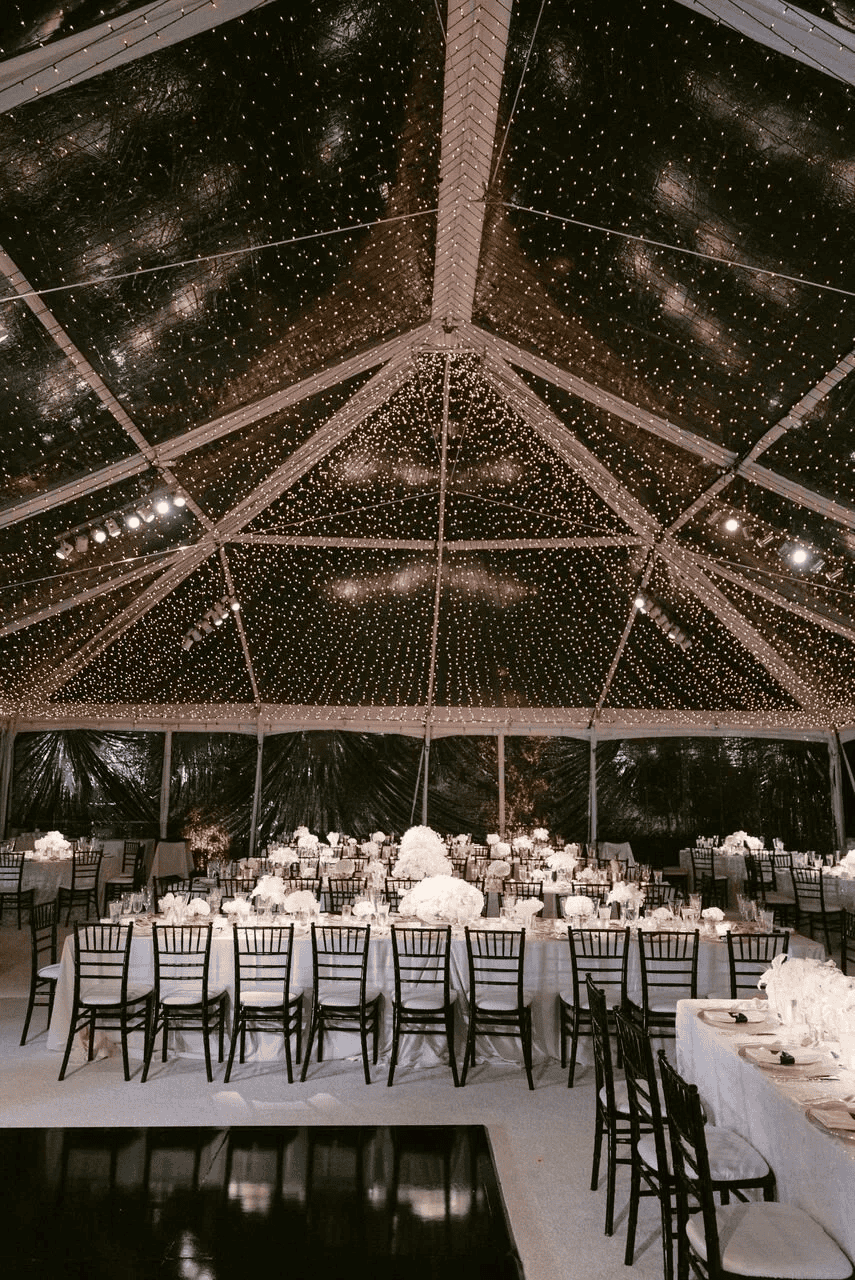
That swap buys you something no fabric roof can give you. After sunset the roof stops reading as a ceiling. You get open sky, the tops of the trees, string lights hanging in what looks like nothing, and a chandelier that hangs against dark air instead of against a white panel two feet behind it. On a property chosen for its view, the view keeps going up. It is the most requested roof we hang over a reception that runs late.
It also takes something away, and that something is shade. A white top is a filter. Clear panels are a window, and a window over a room full of people on a June afternoon behaves the way a window always behaves. That is the whole decision, and it comes down to two things: the month, and the hour the doors open.
Real installs
Clear tops we have put up
Photographs from our own jobs, daylight and after dark. Open any one for the full set.
Browse and build your list
See the clear top inventory
Tents, walls, lighting, heat and cooling sit in one catalog. Put together the list you think you need and we will tell you what the date and the start time actually call for.
Clear top tents
Know this before you book
Four things a clear roof does that a white roof does not
None of these are reasons to avoid a clear top. They are the four conversations we have with every host who asks for one, and each has a fix if you know about it early.
It gains heat in direct sun
Sun straight through clear panels puts heat into the room and the room holds it. Shade from mature trees or a building next door helps a lot. Open sun in full summer wants climate control, and even then the first hour of a midday party is a warm hour.
It sweats on a cold night
Warm bodies and running heaters under a cold roof make condensation, the same way a car windshield fogs. On vinyl nobody notices. On a clear panel you watch it happen. Moving the air and holding steady heat instead of blasting it on and off is how we keep it off the roof.
Rain arrives as a picture
Rain on a clear roof is something you see as well as hear. Plenty of hosts call it the best part of the night. Others find a hard shower busy over toasts. Either way it is not a surprise we want you having at eight o'clock on a Saturday.
Nothing bounces the light back
A white top throws light back down onto the tables. Clear panels send it out into the dark and keep going. Every fixture under a clear roof has to be hung, aimed and powered on purpose, because the ceiling is not doing any of the work for you.
Season plus start time
Clear top suitability checker
Two questions decide whether a clear top is a good idea at your event, and neither one is guest count. Pick the month and the hour the doors open. The answer tells you how the room will feel and what has to go in the quote alongside the tent.
Late afternoon means guests arrive while the sun is still up and the party runs past sunset, which is how most receptions on Long Island actually run.
Spring sun sits lower and the air underneath it is still cool, so a clear roof reads bright rather than hot. A still, cloudless afternoon can still push the room warm, so keep the sides open and have fans or cooling on the quote you can use or skip on the day.
This is the clear top doing exactly what it is for. Light falls through the roof for the first hour, then the sky takes over during dinner. Spring nights on the Island drop fast once the sun is gone, so heaters and a wall you can close are not optional extras here.
Nothing works against you once the sun is down. Watch the gap between a heated room and a cold April night, because that is the combination that puts condensation on the panels. Steady heat and moving air handle it, and we set the room up that way from the start.
Overhead summer sun through clear panels with no shade over them is a greenhouse, and guests will say so. Pick a solid top for a midday summer party and spend the difference on the room underneath. If the clear roof is the whole point, it takes real cooling, open sides and an honest conversation about the first two hours.
The heat is in the roof until the sun drops off it, so the cocktail hour is the part to solve. Keep the sides open, put cooling in the quote, and where you can, set the tent where trees or a building shade the roof late in the day. Seat dinner after the sun is off it and the night is yours.
This is the case clear tops exist for. A warm summer night, walls left open, and a roof that disappears. Panels hold some of the day's heat for a while, so we plan for moving air rather than heating or cooling, and the lighting does the rest.
The best daytime window of the year for a clear roof. The sun is lower, the air is cooler and the light through the panels is the reason to have one. Early September can still run warm at noon, so keep a cooling option on the quote until the week of.
If we could pick the date and time for a clear top, this is it. The catch is the drop after sunset, which is sharper in October than people expect. Book heat and walls you can close, and let the crew decide on the day whether they go up.
A heated room under a cold clear roof is where condensation shows up. It is manageable and we manage it every autumn with steady heat and air that keeps moving, but it is the reason we ask what time the room warms up rather than only what time guests arrive.
Winter daylight through a clear roof is genuinely nice and the low sun is no problem at all. Everything else is a heating question. The roof is the coldest surface in the room, so heat, air movement and a closed wall line are the whole build, not accessories on top of it.
Sunset comes early enough that you are in the dark before dinner, which suits the tent. The room has to be brought up to temperature well ahead of arrival rather than warmed with guests in it, or the panels fog at the worst moment.
A clear roof over a winter night looks like nothing else we put up. It is also the hardest version to run: condensation, heat loss through the panels and whatever the weather does to a roof everyone can see. Some hosts hear that and still want it. Others pick a solid top and are happier. Both are fair answers.
The part hosts underestimate
Under a clear roof, the lighting is the room
Walk into a white tent with a few uplights and it reads as a finished room, because the vinyl overhead catches everything and pushes it back down. Do the same thing under a clear top and you get a dim floor and a black hole above it. The panels are not reflecting anything back to you.
So the light has to be built rather than added. Fixtures get hung where they will be seen from below, string runs are planned against the frame lines instead of draped wherever they reach, and anything pointed upward is pointed at something, because the alternative is pointing it at the sky. We would rather work the event lighting out at the same time as the tent layout than bolt it on two weeks before.
The upside is that a clear top rewards this more than any other tent. Bare bulb strings, chandeliers and pin spots all read as objects floating in dark air, with nothing behind them competing.
What we plan overhead
String runs along the frame lines, so the pattern follows the structure instead of fighting it.
Chandeliers or lanterns hung low enough to light the tables, because the roof will not do it for them.
Table and perimeter light doing most of the real work, aimed down and across rather than up.
Power routed at layout, not after, so cable does not cross a floor guests walk on.
Same tent, different roof
Clear top against a solid top, line by line
Most hosts arrive deciding between these two. The frame, the footprint and the install are close to identical. Everything in this table is what actually changes.
| What changes | Clear top | Solid top |
|---|---|---|
| Midday in summer | Heat builds and stays. Wants shade, cooling or a later start. | The roof filters the sun and the room sits cooler on its own. |
| After sunset | The ceiling disappears. Sky, trees and lights with nothing behind them. | A warm enclosed room. A sailcloth top glows from inside instead. |
| Lighting | Has to be hung and aimed. Nothing bounces back down. | The roof reflects light around and does half the work for you. |
| Photographs | Depth overhead, real sky, light sources reading as points in the dark. | Even, soft, forgiving light on a clean surface. |
| Upkeep on site | Panels have to be clean and stay clean. Sap and pollen show at once. | Marks that would show on glass go unnoticed on vinyl. |
How the job runs
From the sun check to the empty lawn
Six stages, in the order our crew works them. Two of them exist only because the roof is clear.
Site walk and sun check
We measure the usable area the way we would for any tent, then add one question: where the sun is at the hour your event runs, and what stands between it and the roof. Trees, a house or a neighboring building all change the answer.
Layout and the climate call
We draw the footprint, then decide heat or cooling in the same conversation instead of leaving it as a line item. On a clear top that call is part of the tent, not an accessory, and it changes the power plan too.
Panel prep in Holtsville
Clear panels get washed and inspected on our racks before they are loaded. Anything scuffed or clouded stays home. This is real work and it is the reason a clear top from us looks like glass rather than like a used window.
Frame, roof and walls
Frame goes up and gets anchored to whatever it is standing on, stakes into turf or ballast onto hardscape. Then the panels go in, and the wall line gets built to the plan, open, windowed or solid.
Light, heat and a final wipe
Lighting is hung and aimed, heaters or fans are set and tested, and the panels get their last clean once nobody else is going to touch them. That order matters: the wipe is the last thing that happens.
Event and strike
Somebody who knows your install stays reachable through the night, so a wall that has to come down or heat that has to come up is a phone call. We strike on the agreed day and the ground goes back to being ground.
What moves the number
Six things that decide what a clear top costs
We price the tent and the room under it as one job, because on a clear top they are one job. These are the factors we work through before quoting anything.
Span and frame type
A wider clear span carries more weight in the frame and takes more crew hours than the same floor area in a narrower tent.
How much of it is clear
A clear roof with solid walls, a clear roof with window walls, or clear everywhere are three different builds. The wall and sidewall options are usually where hosts fine tune both the look and the number.
Heat or cooling
Almost every clear top we install carries one or the other, sized to the space and the date. This is the single biggest swing on the quote and the one most worth getting right.
The lighting build
Hung fixtures, string runs and the power to feed them are a bigger part of a clear top budget than a white tent budget, for the plain reason that the roof contributes nothing.
Surface and access
Turf takes stakes. Pavers, decking and asphalt take ballast, which means weight on the trucks and time on site. A crew that can back up to the spot works faster.
How long it stands
One night and a full week are different jobs. A longer stand means more weather checking, and on a clear top it usually means going back to clean the panels again before the event.
Local conditions
What Long Island does to a clear roof
Three site conditions come up again and again out here, and all three land on the one surface you can see through.
Open water and open sky
A waterfront lawn on the South Fork or a bayfront property takes wind with nothing to break it, so the anchoring gets heavier and the wall plan has to be able to change during the night. There is also no tree line shading the roof, which pushes a summer event later in the day.
Old trees overhead
The mature oaks that make a North Shore property worth tenting also drop pollen, sap and leaves onto a roof every guest is looking at. Tree cover is a gift for daytime shade and a job for the crew, so we plan where the tent sits and when the last wipe happens.
Hardscape and city sites
Pool patios, courtyards, terraces and parking areas mean ballast instead of stakes and a frame laid out so no leg lands where people walk. In the city there is a second factor: glass towers around you throw light and reflection into a roof that hides nothing.
In our customers' words
Hosts who let us plan the whole room
We sit at 4.9 stars across 138 Google reviews. Three of them, word for word.
"Mike was incredible and guided me through the entire planning process for my wife's surprise 40th birthday party. He brought several important items to my attention that I would never have considered until it was too late. TGIF has a huge inventory with something for everyone. They helped make my wife's birthday incredibly special!"
"I had a corporate event with TGIF, and I still can't get over how easy they made everything. Every detail needed to be perfect, and somehow the result was even better than perfect."
"TGIF handled my event in Suffolk County, and they absolutely exceeded my expectations. The setup was perfect, the event went beautifully, and the team did an excellent job."
Straight answers
What hosts ask before they book a clear top
Talk to us
Give us the date and the hour it starts
With those two facts and an address we can tell you whether a clear top is the right roof for your event, what it will take to run it well, and what we would put up instead if the answer is no.