
Tent Rentals / Jumbo-Trac Tent Rentals
Jumbo-Trac tent rentals, for a footprint a narrow span will not cover
Jumbo-Trac tent rentals answer one question, and it is a width question: how much open ground can a single roof cover with nothing standing underneath it. If you have a floor plan, a vehicle, a stage or a seated crowd that a narrower tent keeps interrupting, this is the page for you. If your problem is total guest count rather than width, the answer may be a joined run instead, and this page will tell you when.
The width question
What changes when a clearspan gets wide
Length is easy. A clearspan grows longer by repeating the same section, and a longer tent is mostly a bigger version of the tent you already had. Width is not like that. The span is decided once, in the engineering of the frame, and it cannot be changed on site or talked up on the phone. You either have a roof that reaches across your floor plan or you have two roofs.
The reason a wide span is a different animal is that every leg is carrying more roof. Uplift per leg climbs, the frame members get longer and heavier, and the crew needs a lift and room to work rather than a ladder and an afternoon. How a clearspan frame is engineered in the first place is covered on the structure tent rentals page, so this one stays on what width specifically does to the job.
The good news is that width buys exactly what a big event usually wants: a floor with nothing in the way of it. The honest news is that it asks for ground, access and time in return, and there is a real point at which two narrower tents are the better answer.
On the ground
Wide spans our crew has covered
Browse and build your list
See what is on the rack
Our live catalog carries the wide clearspan frames along with the walls, doors, flooring and climate gear that go under them.
Jumbo-Trac structures
The argument for it
Four things a wide span buys
A floor plan with nothing in it
Tables, dance floor, bars and staging land where the event wants them, not where a pole allows them. On a wide span the plan is drawn against the perimeter and the ceiling only.
Room to drive in and turn
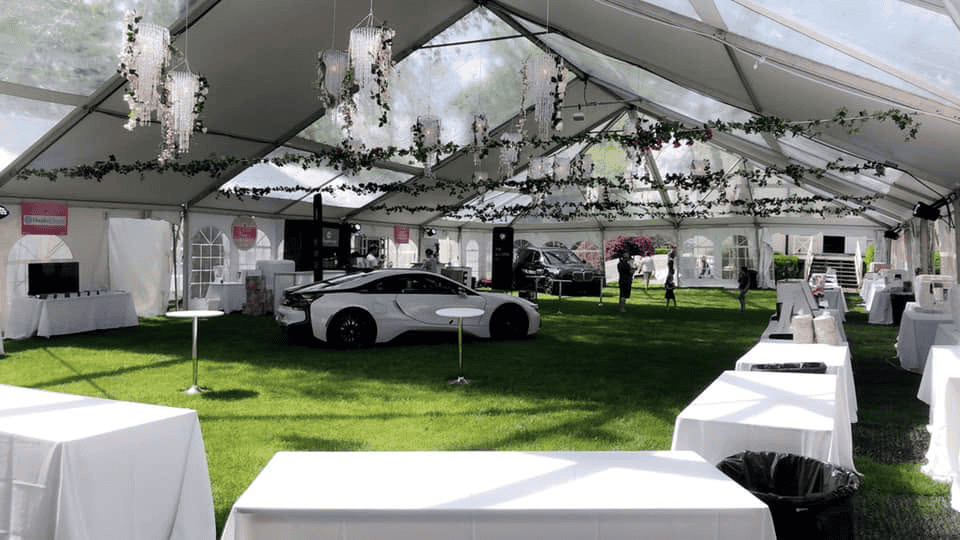
A car on a turntable, a boat, a piece of plant or a stage truck needs to get in, get positioned and get back out. Turning room is a width problem before it is anything else.
Aisles that run the whole way
An expo or trade show floor is booths back to back with aisles between them. Aisles have to run without interruption, which is the thing a row of legs down the middle destroys.
A crowd that can all see
A head table, a stage, a screen or a speaker only works if the room has sightlines. Width is what lets a seated crowd spread sideways instead of stretching back into the cheap seats.
Answer honestly, get a straight answer back
Wide span or a joined run
Five real situations. Pick the one closest to yours and you get a verdict and the reasoning behind it. We would rather you arrive at the phone call already knowing which argument you are having.
Verdict: one wide span
Everyone is looking at the same thing, so the room has one job and a leg line ruins it.
Spread the seating sideways rather than backward and the furthest guest is closer to the stage, not further from it.
Why width wins here
Joining two tents puts a row of legs and a gutter line down the middle of the room. It is a dry, finished join, but it is still a line of upright metal, and it will land between some tables and the thing those tables are pointed at.
A wide span also changes the shape of the crowd. The same headcount laid out wide sits in fewer rows, which shortens the distance to the stage and takes pressure off the sound and screen plan.
Verdict: one wide span, in most cases
Aisle runs and booth rows are laid out on a grid, and a leg line breaks the grid wherever it falls.
A joined run works only if the plan is drawn around the join from the start.
Why width wins here
Exhibitors buy a rectangle. If a leg lands inside one of those rectangles, somebody has paid for a space with a post in it, and that is a conversation nobody on your side wants to have on load-in morning.
There is an exception. If the site itself is long and narrow, a joined run down its length can be the better fit, because the aisles then run parallel to the join rather than across it. Send us the site dimensions and the floor plan together and we will draw it both ways.
Verdict: one wide span
Anything that drives in has to turn, and turning radius is width, not floor area.
The entrance has to be tall and clear as well as wide, so the gable end gets planned first.
Why width wins here
People underestimate this one. A vehicle can fit under a narrow tent and still be impossible to position, because getting it square to the display takes more room than parking it does. The same applies to a forklift placing equipment or a stage truck backing in.
Flooring matters here too. Driving onto turf without protection is how a lawn gets ruined and a wheel gets buried, so the floor plan and the surface plan are one conversation.
Verdict: a joined run
Different zones want different walls, different climate and different hours.
A run lets you close one section early and leave another open, which one roof cannot do.
Why joining wins here
Food service, a bar, seating and a performance area all behave differently. One wants solid walls and heat, one wants to stay open to the air, one needs to go dark. Under a single wide roof you are drawing those boundaries in drape, which is a compromise on every side of the line.
Separate structures linked with gutters or covered walkways give you real rooms with dry walks between them. That is the usual shape of a festival tent site plan.
Verdict: narrower tents, joined or separate
A wide span needs a flat rectangle. Sites that are not rectangles fight it.
Smaller structures step around trees, grade changes and driveways.
Why joining wins here
Slope is the quiet one. Across a narrow tent a grade change is absorbed. Across a wide one the same grade is a real difference in leg height from one side to the other, and it has to be dealt with by shimming, by cribbing or by choosing somewhere else.
Trees do the same thing from above. A limb that clears a small tent will not clear a taller, wider one, and nobody wants to find that out with the frame half up. If the guest count rather than the shape is what is pushing you bigger, read large tent rentals first.
The other side of the ledger
What a wide span asks for in return
| What it demands | Why width causes it | What we need from you |
|---|---|---|
| Flat ground across the width | A grade you never notice on a lawn becomes a leg standing proud at one corner. | Where the low corner is, and whether the site can be graded or has to be shimmed. |
| More anchoring at every leg | Each leg carries more roof, so uplift per leg climbs with the span. | The surface, and whether stakes are permitted or ballast is the only option. |
| A longer install window | Longer, heavier members, a lift on site and a bigger crew than a small tent needs. | How many days you can hand us the site, and the hours the venue or town allows. |
| Room to work beside the footprint | Sections are laid out and assembled on the ground before anything rises. | The clear area around the rectangle, and where trucks can stand while we unload. |
| Truck and lift access | Nothing on a wide frame carries in by hand across a long lawn. | Gate widths, turning room, soft ground, and anything a loaded truck cannot cross. |
| Overhead clearance | A wide roof is a taller roof, so limbs and lines that cleared your last tent may not. | Wires, branches and anything else above the footprint, ideally photographed. |
Long Island adds its own version of each row. Spring ground on the North Fork gives under a heavy load in a way August ground does not. A wide roof on a waterfront lawn is a large surface facing open water. City and hardscape sites rule out stakes entirely, and ballast requirements rise with the span, which means more weight arriving on more trucks. We would rather find all of that on a site walk than on install morning.
The honest version
When we will tell you to join two narrower tents
A wide span is not a prize. It is the right tool for some jobs and the wrong one for others, and the difference is usually the site rather than the event.
Your site is not a rectangle
Mature trees, a driveway cutting through, a pool, a terrace at a different level. Narrower structures step around all of that. A wide span has to sit inside one flat rectangle or it does not sit at all.
You want rooms, not a room
A general session plus breakouts, a dining tent plus a catering tent, a public area plus a back of house. Separate structures with dry links give you walls that are actually walls.
Access decides it for you
If a truck and a lift cannot reach the footprint, the widest frame in the warehouse is academic. Narrower sections travel and place in conditions a wide frame cannot.
How the job runs
A wide install is a schedule, not a morning
Survey and the level check
We measure the rectangle that is actually buildable, check the fall across the width rather than along the length, find what is buried and what is overhead, and settle the surface question so anchoring can be drawn.
Lay-down and set out
Sections arrive and get laid out beside the footprint in build order. Base positions are marked and squared. This stage is why we ask for working room around the tent and not just the tent's own area.
Raise, roof and anchor
Frames go up bay by bay with the lift, the roof is drawn through the track and tensioned, and anchoring is completed as the structure rises. Walls, doors and flooring follow once it is closed.
Event, then strike
We stay reachable through the event and re-check tension and anchoring on a multi-day stand. Breakdown reverses the build, and we walk the ground with you before the trucks pull out.
No prices here, just the levers
Three things that move a wide-span number
The span itself
Width costs more per covered foot than length does, because length repeats a section you already have and width calls for a different frame entirely.
Ground, anchoring and access
Ballast on hardscape, ground protection on turf, a lift on site, and a long carry from the truck all show up as hours and equipment before they show up anywhere else.
Days on site and what goes inside
Install and strike are both longer on a wide frame. Flooring, walls, climate and lighting then add their own build time on top of the structure.
All of it is done by our own crew with our own equipment out of the Holtsville warehouse. That is not a slogan on a job this size: a wide install has a sequence, and a sequence works when one company owns the trucks, the frames and the people who put them together. The family started with two tents in 1975 and there are more than 1,000 on the racks now. If the site plan needs more than tents, our event production team covers the rest of it.
In our customers' words
Clients who needed the whole footprint covered
"I had a corporate event with TGIF, and I still can't get over how easy they made everything. Every detail needed to be perfect, and somehow the result was even better than perfect."
"Mike was incredible and guided me through the entire planning process for my wife's surprise 40th birthday party. He brought several important items to my attention that I would never have considered until it was too late. TGIF has a huge inventory with something for everyone. They helped make my wife's birthday incredibly special!"
Straight answers
Questions we get about wide spans
That depends on which frames are on the rack for your date and, just as much, on whether your site can take the widest one. We would rather answer it with your numbers than with ours. Send the rectangle you need covered, the address and the date, and we will tell you whether one roof does it, what the ground has to look like for that to work, and what the joined alternative would be.
They are not really substitutes, so the comparison rarely comes down to the number alone. A wide span asks for flatter ground, heavier anchoring, more access and a longer build. A joined run asks for more perimeter, more walls and a gutter line through your floor plan. Nine times out of ten the site and what has to happen inside decide it, and the quote follows that decision rather than driving it.
Yes, and lots are one of the better surfaces for it because they are flat and they drain. Nothing gets driven into asphalt or concrete, so every leg takes engineered ballast instead, and the amount of it rises with the span. That means more weight delivered and placed, so the lot has to carry the trucks as well as the tent. Tell us who owns the surface and what they allow, because that answer changes the plan more often than the tent does.
Usually. Tents past a certain size generally need approval before they go up, and something this wide is past it almost everywhere on Long Island. What each town and fire district asks for varies, and some want it well ahead of the date. Give us the address early and it becomes a scheduling item rather than a scramble in the last two weeks.
Next step
Send us the rectangle you need covered
The dimensions, the address, the date and what has to happen underneath. We will come back with whether one wide span covers it, what the ground would need to be, and what a joined run would look like instead.