
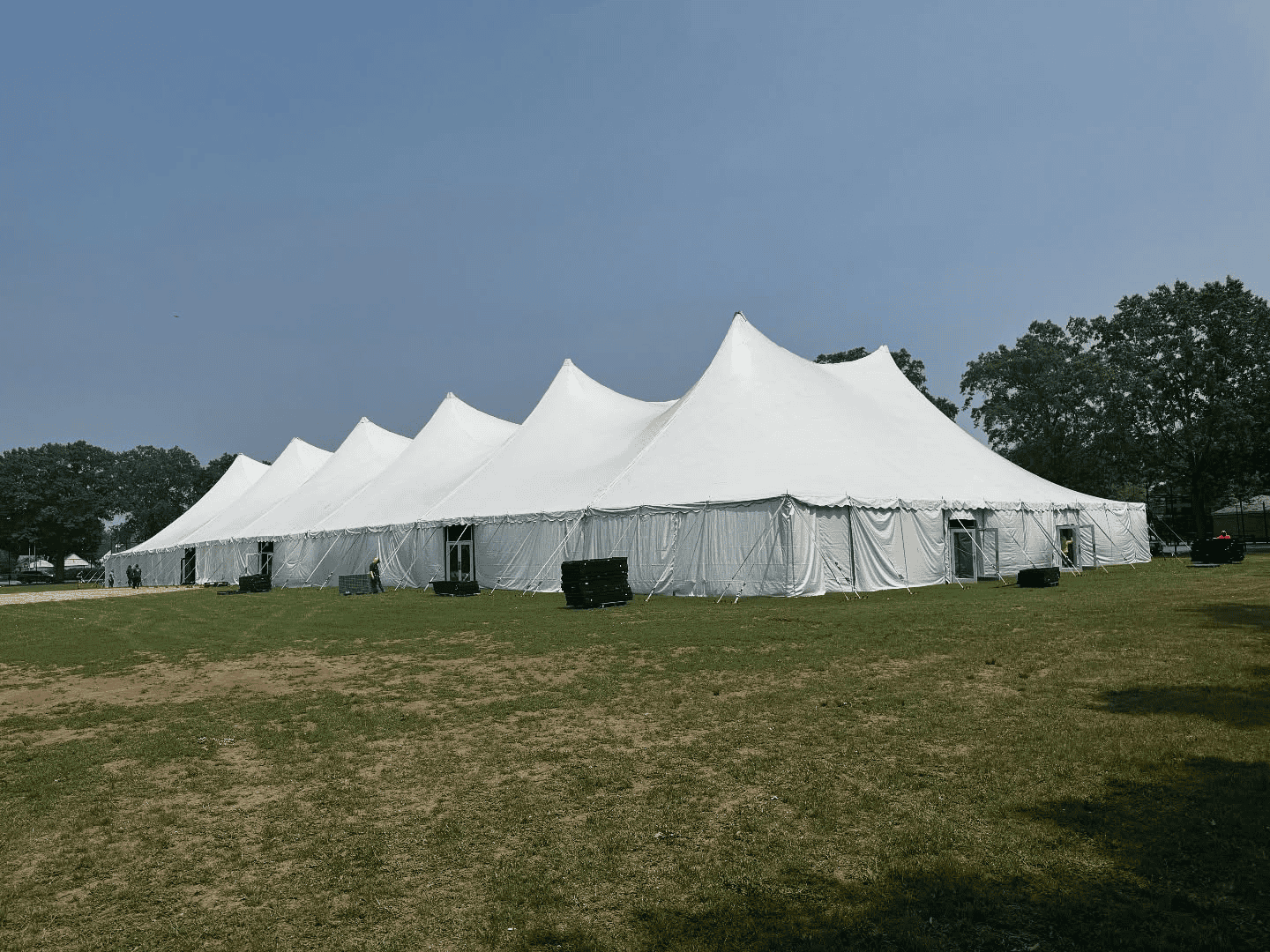
Tent rentals from a fleet of more than 1,000 tents
We run tent rentals across Long Island and New York City out of our own warehouse in Holtsville, with our own trucks and our own install crew. Sailcloth, high peak, clear top and engineered clearspan, from a backyard dinner up to a festival span.
The operation behind the rental
We own the tents, and that changes the whole conversation
Every tent we quote is sitting on a rack at 100 Corporate Drive in Holtsville, right off the Expressway. We bought it, we store it, we wash it and repair it between jobs, and our own crew puts it up. Nothing on your quote is being chased down from another rental company on the Friday of your event.
The fleet started at two tents. The family opened in 1975 as a DJ and entertainment company, Michael Biondi took the business over in 2007, and the tents arrived as the work grew into full event production. It is past 1,000 now, in more sizes and shapes than any single event needs, which is the point.
In practice it means the person quoting your tent can walk out and look at it. If the size you want is already committed to another Saturday, you hear that on the first call instead of three weeks out. And when something changes on site, you are talking to the company that owns the canvas, not a dispatcher at a firm we hired.
Browse and build your list
See the tent inventory
Sizes, styles and availability for the full tent fleet, straight from the system our warehouse runs on.
Tents and canopies
Sidewalls and window walls
Before you pick a style
Five things decide which tent goes on your property
Hosts usually start with a picture in their head. We start here, because these five answers rule most of the catalog in or out before anyone talks about how it looks.
| The decision | Why it matters | What it settles |
|---|---|---|
| Guest count and what they are doing | A seated dinner takes roughly double the floor of a standing cocktail hour, and the dance floor, the bar, the buffet and the band each need their own square footage on top of the tables. | The size band, which then narrows the families that come in that size. |
| The ground it sits on | Lawn takes stakes. Pavement, driveway, decking and rooftop take ballast instead, and ballast needs room around the perimeter. Sand and soft ground near the water hold a stake differently than packed loam. | Which anchoring method the job uses, and which families are even possible. |
| Season and exposure | Spring ground on the North Fork stays soft late. Open water on the East End pushes wind at a tent that an inland yard never feels. Late fall means sidewalls, flooring and heat, not just a roof. | Anchoring, sidewalls, flooring and whether you need climate control. |
| The look you are after | A wooden pole under a glowing top reads nothing like a clean modern clearspan, and a transparent roof under string lights reads different again. This is the part hosts care about most and we save it for last on purpose. | Sailcloth against high peak against clear top against clearspan. |
| How long it has to stand | One evening is a different job from a five day festival build or a production that needs the structure up for two weeks with equipment hanging off it. | Whether an engineered structure is the right call, and how early the paperwork conversation starts. |
Find your starting point
Tent style router
Answer three questions and we will tell you which family we would quote first, what we would price alongside it, and what your ground is going to demand. It is where our estimators start, not a replacement for the site walk.
Wooden poles, a translucent top that glows once the lights come on, and swooping lines that sit well on a lawn. It is the tent most backyard weddings on the East End are picturing.
Stakes drive straight into lawn, so anchoring is the simple part. We still probe for irrigation lines, septic fields and buried utilities before anything goes in the ground.
Tents by shape and build
Eight families, and the job each one is built for
These are the structures themselves. Pole and peak tents get their shape from tension and interior poles. Clearspan tents get theirs from an engineered frame, which buys you an open floor and a tent that can stand for days.
Sailcloth
Wooden poles and a translucent top that glows at dusk. The warmest looking tent we carry, and the one most backyard and waterfront weddings ask for by name.
Sailcloth tent rentals
High peak
Pointed peaks on a metal frame. You get shape and height overhead without a center pole planted in the middle of your dance floor.
High peak tent rentals
Clear top
Transparent roof panels, so the sky and the string lights stay part of the room. Best after dark. Daytime use wants a shade or cooling plan alongside it.
Clear top tent rentals
Levo
A low profile clearspan with clean modern lines and no interior poles. Good where a tall peak would fight the house or block a view.
Levo tent rentals
Navi-Trac
An engineered clearspan that ballasts onto hard surfaces and takes sidewalls, glass doors, flooring and climate control cleanly.
Navi-Trac tent rentals
Jumbo-Trac
The wider engineered clearspan. Same system, longer spans, for crowds and equipment that outgrow a standard frame.
Jumbo-Trac tent rentals
Structure tents
Heavy clearspan structures with no interior poles, built to stand for days, carry rigging and take a real door and floor.
Structure tent rentals
Large format
Where one tent stops being enough. Spans and multi-bay layouts for guest counts past what a single standard tent covers.
Large tent rentals
Tents by the job
Same fleet, very different jobs
The structure is only half the answer. What the tent is for changes the layout, the load-in schedule, what hangs from the frame and who else is working under it.
Weddings
A private property turned into a venue for one night. Ceremony, cocktail hour, dinner and dancing all have to fit, and the tent has to look like it belongs on that lawn.
Wedding tent rentals
Luxury installs
Upgraded finishes, glass doors, hard flooring, chandeliers and full climate control. The tent stops reading as a tent and starts reading as a room.
Luxury tent rentals
Corporate events
Company picnics, product launches and client days, usually on a parking lot or a campus lawn with a fixed load-in window and branding to hang.
Corporate tent rentals
Festivals
Multi day builds with vendor rows, stages, beer tents and public crowds. Engineered structures, a site plan, and a schedule that works around the public.
Festival tent rentals
Commercial and retail
Seasonal sales, sidewalk and lot coverage, warehouse overflow and temporary work space. Long standing times and hard surfaces are the norm here.
Commercial tent rentals
Film and production
Base camp, catering, wardrobe and holding for a shoot. Fast builds, odd hours, and structures that go up where the location scout says they go.
Production tent rentals
Rooftops and terraces
City installs where nothing can be driven into the deck, everything arrives by freight elevator, and the building sets the weight limit before we set the tent.
Rooftop tent rentals
Disaster relief
Emergency shelter, staging and triage space when a town needs covered ground quickly. Shortest notice work we do, and the reason we keep depth in the fleet.
Disaster relief tent rentals
Everything that hangs off the tent
Sidewalls and window walls, flooring and subfloor, lighting, heaters and fans, doors, liners, gutters between bays, and the stakes and ballast the anchoring plan calls for. Most of what makes a tent usable is on this list rather than in the tent itself.
Tent accessories
Out of our own fleet
Tents we have put up
Rope and pole, clear top and high peak installs across Long Island. Tap any photo to open the full set.
How a tent job actually runs
From the site walk to the empty lawn
Every tent we put up runs the same four stages, whether it is a 40 person dinner in a backyard or a week long build on a parking lot.
Site survey and layout
We walk the ground and measure the usable area, not the lot. Slope, trees, irrigation, septic, overhead wires, and how a loaded truck gets in and turns around. Then we draw the footprint with the dance floor, bar, buffet and seating where they belong.
Paperwork and scheduling
Most towns and most venues want documentation on a tent before it goes up, and what they ask for is not the same from one town to the next. We work out what yours wants and set the install window around it.
Delivery and install
The tent, the flooring, the lighting, the power and the furniture leave Holtsville on one manifest. Our crew stakes into ground or ballasts onto hard surface, then builds out the sidewalls, the lights and the floor plan you approved.
Event day and breakdown
We stay reachable while the tent is standing. If the wind picks up or something has to move, you are calling the people who own it. We come back on the agreed day, strike, load out and leave the ground the way we found it.
In our customers' words
What hosts say after the tent comes down
"I was looking for an elegant setup for my event, and TGIF knocked it out of the park. Their sailcloth tent looked incredible, and the final result exceeded my expectations."
"We rented our tent from TGIF for our backyard wedding, and it was one of the best decisions we made. We weren't sure a tent would work around our pool, but Mike reassured us that his team could make it happen. He was quick to answer every question, and the setup team was prompt and professional. Highly recommend!"
"TGIF handled my event in Suffolk County, and they absolutely exceeded my expectations. The setup was perfect, the event went beautifully, and the team did an excellent job."
Straight answers
What hosts ask us about tent rentals
Talk to us
Tell us the date, the address and the head count
That is enough for us to tell you which tent fits your property, what the ground is going to need, and whether the date is still open. Call and you get someone who has put a tent up on ground like yours.