
Tent Rentals / Sailcloth Tent Rentals
Sailcloth tent rentals, and the honest version of what you get
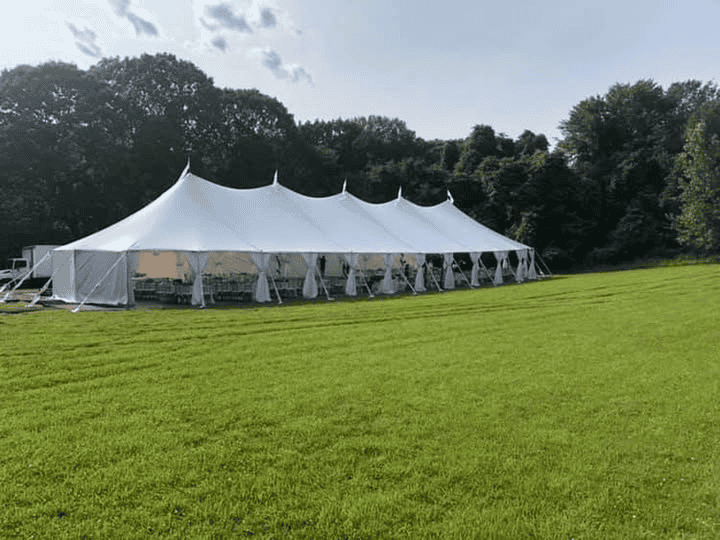
Sailcloth tent rentals are the ones people ask for by name, usually after standing under one at somebody else's wedding. A translucent woven top, wooden poles, a roofline that swoops instead of running flat, and a tent that glows outward across a lawn once the light goes. It is the most beautiful tent we own. It also asks more of your property than any other tent we own, and this page says so.
Start with the material
It is a different fabric, not a different color of the same tent
Most tents are topped with a coated vinyl. It is opaque, it is durable, and light bounces off it. A sailcloth top is a woven fabric closer in character to a boat sail, and the difference you notice is that light comes through it rather than stopping at it. Stand under one at two in the afternoon and the room is filled with warm daylight instead of lit by the open sides.
The structure underneath is different too. A frame tent is held up by an aluminum skeleton. A sailcloth is a tension structure: wooden poles push the high points up, the perimeter is anchored down and out, and the fabric between them is pulled tight enough to hold its own shape. That tension is what produces the swooping roofline and the scalloped edge that people recognize from photographs, and it is also why the poles are not optional.
Every choice in that description buys the look and costs something else. The wooden poles stand inside your room. The shape cannot be squared off. The anchoring wants ground that takes a stake. None of that is a flaw in the tent, but all of it is a fact about your night, and it is better known in March than found out in September.
If you have a photograph saved from a wedding blog and you are trying to work out what tent it is, look for two things: wooden poles rather than metal, and a roof that dips at the edges instead of running straight. That is a sailcloth almost every time.
From our own installs
Sailcloth tents at every hour of the day
Open sides at midday, amber tops at sunset, lit interiors after dark. The same three hours you just read about, on real Long Island properties. Tap any photo to open the full set.
Browse and build your list
See the sailcloth inventory
Sizes, poles, lighting and everything that goes underneath, straight from our live rental catalog.
Sailcloth tents
Piece by piece
What each part of the tent is, and what it means for you
Six components, and the practical consequence of each one on the night.
| The part | What it means on your property |
|---|---|
| The translucent top | Daylight passes through instead of reflecting off, so the interior is bright and warm at midday and holds the last of the light at dusk. It also means the tent is never a dark room, which matters if you were planning a projection screen or a late dance floor that goes properly black. |
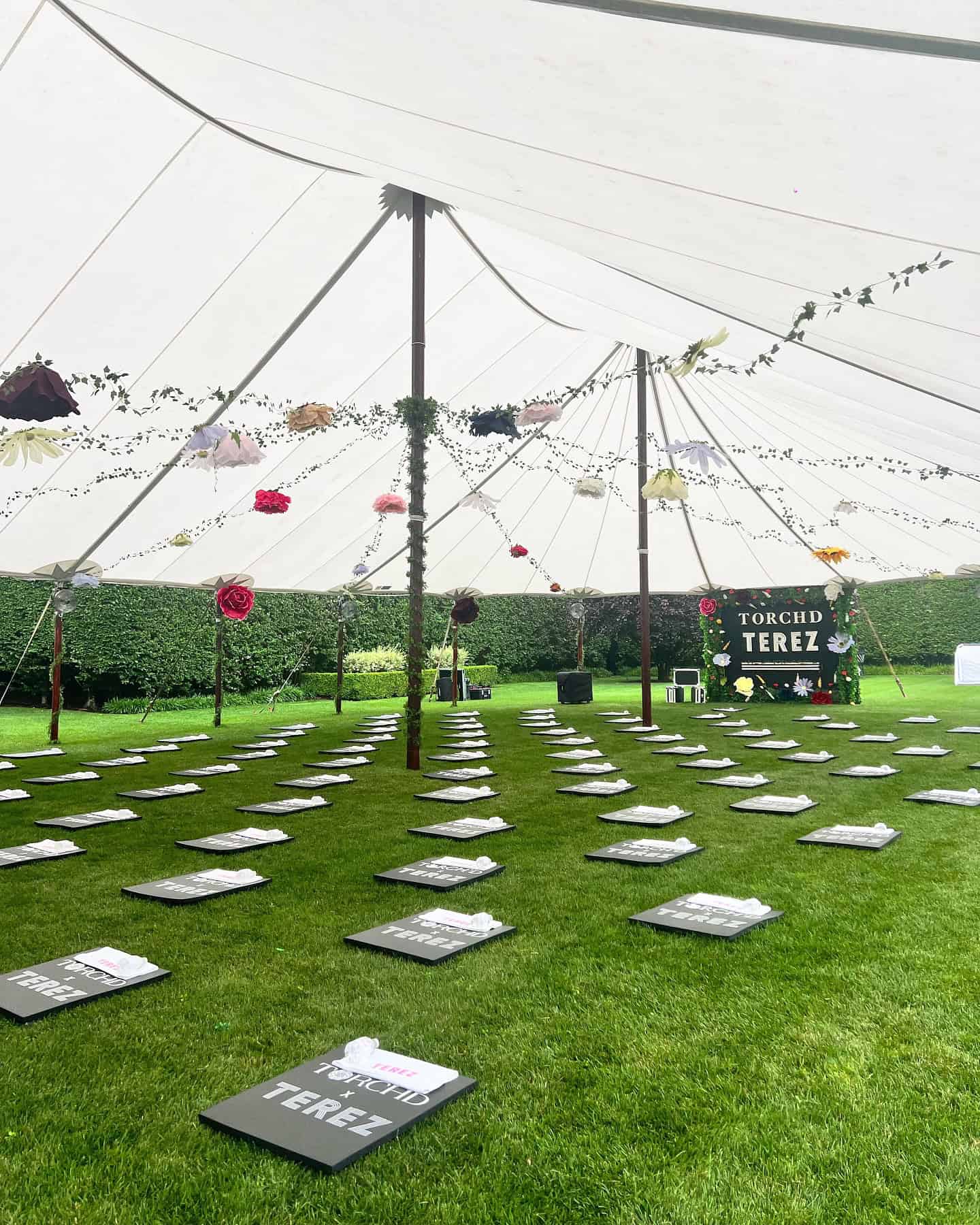
| The wooden center poles | They stand inside the room, not outside it. They are handsome, they take greenery and light well, and they are immovable. A seating plan, a head table and a dance floor all get drawn around them rather than through them. |
| The swooping roofline | The roof rises at each pole and falls between them, and the eaves scallop rather than running level. It is the silhouette people are buying. It also means interior height varies across the room, and the lowest points sit at the perimeter where your perimeter tables are. |
| The anchoring | Tension holds the shape, so the perimeter has to be staked out and down into ground that will hold. This is a lawn tent by design. On hard surfaces the anchoring gets complicated fast and another tent type is usually the better answer. |
| The walls | Available, and used less often than on other tents, because closing a sailcloth trades away the thing you rented it for. Most hosts run it open and keep walls on hand for weather. We bring them either way. |
| The sizes | Sailcloth comes in defined sizes. It does not extend a foot at a time and it does not join into an endless run the way a frame tent does. You are choosing between real steps, and one of them will be slightly too much or slightly too little for your count. |
The same tent, three times in one day
What the light does to it, hour by hour
A translucent top makes the tent behave differently at midday, at golden hour and after dark. Most of the lighting decisions on a sailcloth come out of that, so pick an hour and read what actually happens under it.
Midday: bright, warm and unusually kind to faces
What you see
A room full of daylight with no hard edge to it. The top diffuses the sun the way a softbox does, so there is no glare, no hot patch crawling across the tables and no shadow line cutting the room in half at one o'clock. The white of the fabric picks up a faint warmth that reads well on skin and on white linen.
What it means for lighting
Nothing you install will be visible. Fixtures that look lovely in a photograph at nine will do nothing at one, so a daytime ceremony or a lunch does not need a lighting budget, only a plan for later. Anything meant to be seen in daylight has to be physical: flowers, fabric on the poles, the table itself.
What to plan
Heat, not darkness. A translucent top lets warmth in as well as light, so a July afternoon under sailcloth is warmer than under a vinyl top. Keep the sides open, plan airflow across the room rather than into one wall, and talk to us about cooling before you decide the walls are staying up.
Golden hour: the twenty minutes the tent was built for
What you see
The top goes amber. Low sun comes through the fabric rather than across it, so the whole ceiling warms at once and the poles and the roof seams throw long soft lines down the room. From outside, the tent starts to look lit before anyone has switched anything on.
What it means for lighting
This is the handover, and it is the part people get wrong. Fixtures brought up too early look weak against the sky and kill the effect. Brought up too late, the room drops into gloom while the caterer is serving. String lights on a dimmer, raised slowly across this window, are worth more here than twice the fixtures switched on at once.
What to plan
Your timeline, against the actual sunset for your date. Photographers will ask for this window and so will the band. Tell us when it falls and we will make sure the lighting is on a dimmer and somebody knows the cue, rather than leaving it to whoever is nearest the switch.
After dark: a lantern on the lawn
What you see
Because the fabric passes light both ways, everything you put inside the tent is also lighting the outside of it. The whole structure glows from the lawn, the driveway and the road. Guests coming back from the house see a lit shape rather than a dark one, and this is the photograph that ends up everywhere.
What it means for lighting
Light the room, not the ceiling. Uplights aimed at a translucent top mostly leave through it, so the work is done by warm sources at eye level and above the tables: string lights from the poles, pin spots on the tables, a fixture at each pole head. Keep it warm and dim rather than bright and even, and the glow does the rest.
What to plan
The ground around the tent. A tent this bright makes everything outside it look darker than it is, so the path from parking, the steps and the edge of the lawn need their own light or guests will find them the hard way. It is the most overlooked line on a sailcloth quote.
Read this part twice
Four things we would rather tell you now
A sailcloth is the right call for a lot of events and the wrong call for some. Here is where it costs you something, in plain terms.
The poles are in the room
There is no version of this tent without them. They land where the structure needs them, not where your floor plan would prefer, and they cannot be moved after the fact. In practice that means the dance floor, the head table and the band all get positioned relative to a pole. Most people end up liking it, because a pole wrapped in greenery is a better centerpiece than empty air. But if you have a layout that needs an unbroken floor, this is not your tent.
The shape is fixed
A frame tent can be added to a unit at a time and turned around an obstacle. A sailcloth is what it is. The roofline, the pole positions and the footprint come as a set, and the sizes step rather than sliding. If your guest count falls between two sizes you are choosing which way to round, and if your lawn is an awkward shape, the tent will not adapt to it.
It is a lawn tent
The tension in the fabric is held by anchoring driven into ground that will take it. Grass, soil and most fields are fine. Asphalt, concrete, a parking lot or a rooftop are not what this tent is for, and forcing it there is worse for you than choosing differently. For hard surfaces we would point you at a structure tent rental instead, which ballasts and gives you straight walls as well.
It will never be a dark room
Translucency works in both directions and all day. On a bright afternoon the room is warm as well as light. On a summer evening, ambient light from the sky lingers inside the tent longer than it does outside. If your plan includes a projection screen, a controlled lighting look or a properly black dance floor, the thing that makes this tent beautiful is working directly against you.
The part under the tent
What has to happen to the ground first
A sailcloth is unforgiving about what it sits on, and not for the reason people assume. It is not only about anchoring. It is that the tent invites guests to look up and out, which means everything at eye level gets looked at too, and a lawn that would disappear under a walled frame tent is fully on display here.
Slope is the first question. The poles set the roof height and the perimeter is pulled down to the ground, so a lawn with real fall across it needs the floor built level rather than the tent stretched over it. Event flooring rentals handle more of that than most hosts expect, and the site survey is where we tell you whether you need a full floor, a leveled platform under the dance area only, or nothing at all.
Soft ground is the second. North Fork fields in spring, a lawn after a wet week, sandy soil near the water: each holds an anchor differently, and a tension structure notices. We test rather than guess, and we bring the anchoring the site actually calls for instead of the anchoring that fit in the truck.
Then the small things that show. Where the cable runs, where the caterer walks, where the bare patch is that nobody notices until four hundred photographs are taken next to it. We walk the lawn with you and point at all of it while there is still time to water, seed or move the tent ten feet.
Lighting a tent that lights itself
Three fixtures do more here than ten do elsewhere
The translucent top changes what works. Plan it as one system with the tent rather than adding fixtures once the structure is standing.
String lights from the peaks
Runs dropping from each pole head out to the eave follow the swoop of the roof and put warm light at the height faces are. This is the workhorse fixture on a sailcloth, and on a dimmer it carries the whole handover from sunset to full dark on its own.
Pin spots on the tables
Narrow beams dropped onto the centerpieces give you pools of light instead of a flat wash, and they keep the room feeling like evening rather than like a lit space. They cost little and they are the difference guests cannot name afterward.
Light at the poles
The poles are already the strongest vertical in the room, so a warm fixture at the head of each one gives the eye something to follow up into the roof. Uplighting the fabric itself is the one thing to go easy on, since most of that light leaves through the top.
All of it comes off our racks with the tent, on one quote and one truck, and our crew hangs it while the tent is going up rather than the morning after. Start with event lighting rentals if you want to see the range before the site walk.
Right tent, right night
Who this tent is actually for
We put up hundreds of tents a year and we are not trying to sell every host the same one. Here is the honest sort.
Say yes if the look is the brief
A lawn wedding on a property you already love, a dinner running from daylight into evening, an anniversary or a milestone that is going to be photographed hard. If the tent is meant to be part of the photographs rather than shelter for them, nothing else we own does this.
Say yes if you have the ground
Open grass, reasonably level, with room around the footprint for the anchoring to sit outside the walls. Most estate lawns and field sites on the East End and the North Shore qualify comfortably. A tight village yard or a courtyard often does not, and we will say so at the survey.
Look elsewhere if the job is practical
Covered walkways, a catering bay, a vendor row, cocktail hour on a driveway or any run of covered ground built to a length: that is what high peak tent rentals are for, and they do it for less structure and less fuss than forcing a sailcloth into the role.
Not sure the sailcloth is the one yet? Wedding tent rentals lays the tent families side by side with a footprint planner, and our wedding rentals page covers everything that goes under whichever roof you land on.
How it goes up
Six stages, in the order our crew does them
A sailcloth takes longer to install than a frame tent of the same footprint. That is the tension doing its job, and we schedule for it.
Site survey
We measure the real lawn, find the fall across it, locate irrigation and septic, and check there is room outside the footprint for the anchoring. This is also where we tell you honestly if the property suits a sailcloth.
Layout and pole positions
The poles go on the plan before the tables do. Dance floor, head table, bar and band all get placed around them, so you see exactly what the room looks like before anything is ordered.
Town paperwork
Most towns want something filed before a tent goes up and no two ask for quite the same thing. Give us the address early and we will tell you what yours usually wants and what we supply.
Anchor, raise, tension
The perimeter is anchored first, the poles go up, and the fabric is tensioned into shape. Tensioning is skilled work and it is what makes the difference between a crisp roofline and a slack one.
Floor, light and finish
Flooring, lighting and anything hanging on the poles goes in while the crew is still on site. We install ahead of your date so you get an evening under it with the lights on and time to change your mind.
Event, then breakdown
We stay reachable through the event and we re-check tension if the weather moves. Breakdown happens on a day agreed with you, and the lawn gets left the way we would want ours left.
What moves the number
Five things that decide what a sailcloth costs
We quote the whole job. These are the factors that actually change the figure on a tent like this one.
Which size step you land on
Sizes come in defined steps rather than sliding to fit. Where your guest count and your seating style put you on that ladder is the single biggest factor, and it is worth settling the seating plan before the tent size.
What the lawn needs
A level lawn that takes an anchor cleanly is the simplest install we do. Real slope, soft ground or a site that needs a built floor adds material, crew time and a day to the schedule.
The lighting plan
On this tent lighting is not a finishing touch, it is half of what you are paying for after sunset. String runs, pin spots and the path lighting outside the tent are all real lines, and they are all worth having.
The install window
Tensioning takes time and it does not go faster for being rushed. An install spread over a comfortable window costs less than one squeezed into a morning because a venue or a neighbor set the clock.
Everything else under the roof
Flooring, tables, chairs, linens, bars, heat and power all come off our own racks in Holtsville and land on one quote with the tent. That is deliberate: a sailcloth priced on its own tells you almost nothing about what the night costs.
4.9 stars across 138 Google reviews
What hosts say afterward
"I was looking for an elegant setup for my event, and TGIF knocked it out of the park. Their sailcloth tent looked incredible, and the final result exceeded my expectations."
"TGIF handled my event in the Hamptons, and I needed everything to look elegant without becoming too expensive. They delivered exactly what I was looking for."
"TGIF provided excellent communication and great service. Our party was a huge success, and everything was delivered at a great price. I will definitely use them again and recommend them to anyone planning an event."
Straight answers
Sailcloth questions we get asked first
Talk to us
Send us the property and the date
We will walk the lawn, tell you whether a sailcloth suits it, show you where the poles land and price the whole night with the flooring, the lighting and the furniture in one number. If another tent is the better answer for your site, we will say that too.